
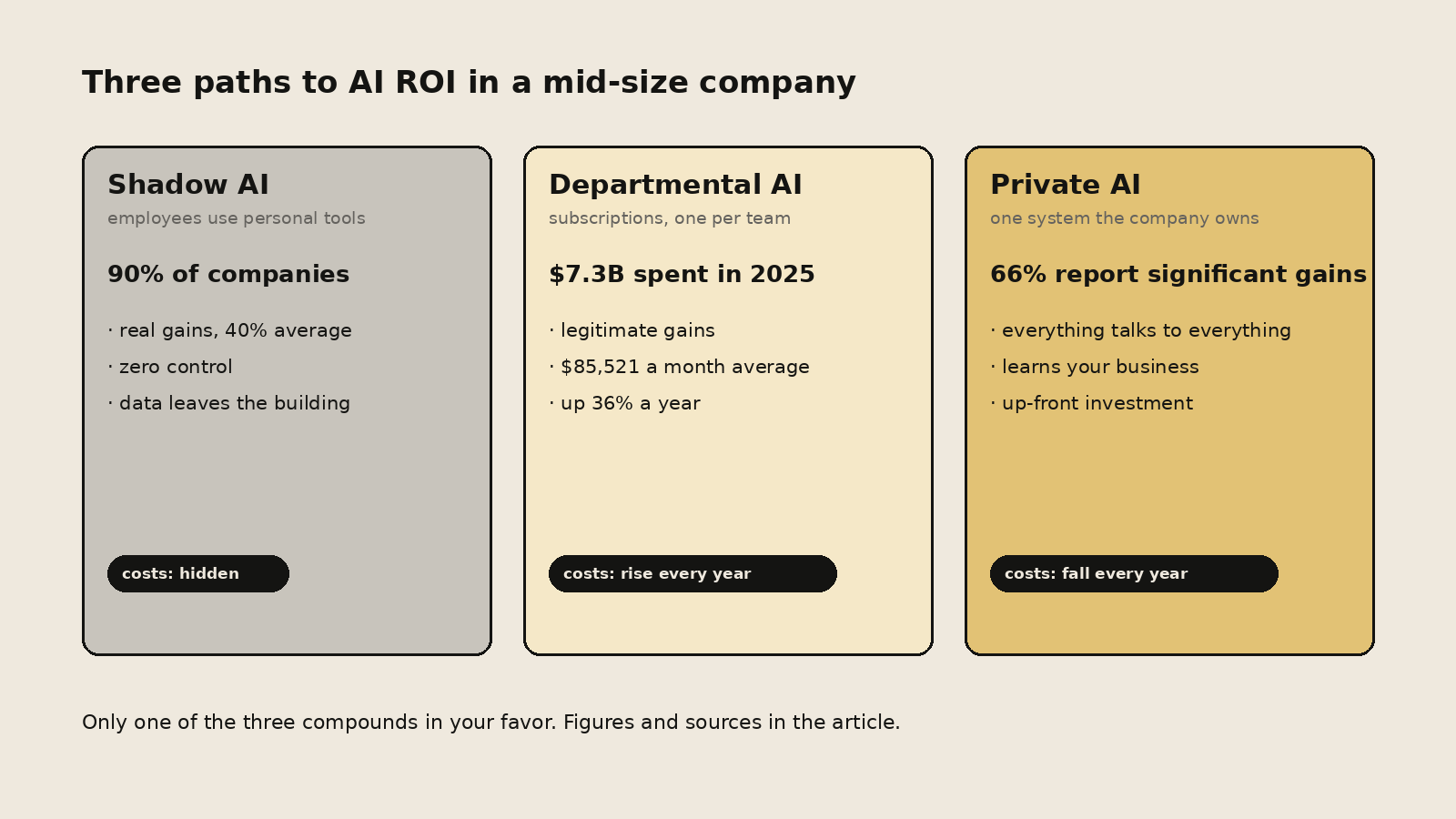
Mid-market companies are getting real productivity from AI in three different ways, and only one of them compounds. Shadow AI, employees using personal tools, is already in 90 percent of companies and delivers gains with zero control. Departmental AI, subscriptions per team, hit $7.3 billion in 2025 and averages $85,521 a month, rising 36 percent a year. Private AI, a system the company owns, costs more up front and less every year after. The numbers, with sources, are below. What we have added since this was first published is the step that comes before owning anything. Map how the work moves first.
The 2026 ROI Reality: What’s Actually Working
Start with what the data shows. Not vendor promises. Results from companies that deployed AI and measured it.
According to EY’s 2025 AI Pulse Survey of 500 senior decision-makers across U.S. industries, 96% of organizations investing in AI are experiencing productivity gains, with 57% reporting those gains as significant. IBM’s study of 3,500 executives across Europe, the Middle East, and Africa found that 66% report significant operational productivity improvements.
Employees on the ground are seeing it too. Research from Upwork shows workers using AI report an average 40% productivity boost, with 77% of C-suite leaders confirming these gains. The Federal Reserve Bank of St. Louis found that workers using generative AI saved 5.4% of their work hours per week, translating to a 1.1% productivity increase across the entire workforce.
These productivity gains are coming from three completely different approaches, with wildly different cost structures, risk profiles, and long-term sustainability.
Mid-market companies (100-500 employees) are uniquely positioned in this transformation. Unlike enterprises that get buried in governance committees, and unlike startups that lack resources, mid-market firms can move fast, MIT research shows top performers report average timelines of 90 days from pilot to full implementation. That speed advantage matters when the technology is evolving this fast.
Path 1: Shadow AI — The Accidental Productivity Gain
In most mid-market companies right now, this is what is happening.
Your employees are already using AI. You just don’t know about it.
According to MIT’s State of AI in Business 2025 report, while only 40% of companies say they purchased an official LLM subscription, workers from over 90% of companies reported regular use of personal AI tools for work tasks. In fact, almost every single person surveyed used an LLM in some capacity.
This “Shadow AI” often delivers better ROI than formal initiatives because it’s completely bottom-up, zero friction, and self-optimizing. An employee hits a bottleneck, opens ChatGPT, gets unstuck, and moves on. No approval process. No implementation timeline. No IT involvement.
The productivity gains are real.
-
5.4% weekly time savings per worker (St. Louis Fed)
-
40% productivity boost on average (Upwork Research Institute)
-
$4.50 return for every $1 invested in AI sales tools (SuperAGI)
-
22% reduction in document processing times for mid-sized companies (Zebracat analysis)
The problem.
Your employees are copy-pasting proprietary information into public platforms. They’re training someone else’s AI on your data. They’re creating workflows that disappear when they leave. And you have zero visibility into what’s being shared, how it’s being used, or what vulnerabilities you’ve created.
A mid-market law firm recently discovered an associate had been using ChatGPT to draft client communications for six months. The productivity gain was undeniable, she was closing cases 30% faster. But every conversation, every strategy discussion, every piece of privileged information had been fed into OpenAI’s training data. The compliance violation would have shut them down if discovered during an audit.
Shadow AI is productivity without control. It works until it catastrophically doesn’t.
Path 2: Departmental AI — The Subscription Treadmill
The “approved” alternative is departmental AI. Buying subscriptions to AI-powered tools for specific functions.
-
GitHub Copilot for your developers ($19-39/user/month)
-
Jasper for your marketing team ($39-125/user/month)
-
Gong for your sales team ($1,500-2,500/user/year)
-
Intercom with AI for customer support ($74-132/user/month)
-
ChatGPT Team or Claude Pro for knowledge workers ($25-30/user/month)
According to Menlo Ventures’ State of GenAI in Enterprise report, departmental AI spending hit $7.3 billion in 2025, up 4.1x year-over-year. Coding captured 55% of that spend ($4.0 billion), followed by IT operations ($700M), marketing ($660M), and customer success ($630M).
Companies are seeing legitimate gains.
-
50% of developers use AI coding tools daily (65% in top-quartile organizations)
-
20% increase in billable hour capacity for a mid-market marketing agency using Notion AI and specialized copywriting tools
-
15% average cart size increase within six weeks for an e-commerce retailer using AI recommendation engines, with ROI achieved in 45 days
-
32% faster decision-making for businesses using AI for data analysis (Zebracat)
The economics are brutal.
CloudZero’s 2025 State of AI Costs report found that average monthly AI spending reached $85,521 in 2025, a 36% increase from 2024’s $62,964. The proportion of organizations spending over $100,000 per month more than doubled, jumping from 20% in 2024 to 45% in 2025.
For a 200-person mid-market company deploying AI tools across five departments, annual costs typically hit $250,000-$400,000. And that number goes up, not down, over time.
-
Subscription prices inflate (SaaS tools average 8.7% annual increases, 5x market inflation rates)
-
Usage-based charges compound (65% of IT leaders report unexpected consumption costs)
-
Tool proliferation accelerates (teams adopt new AI tools for specific use cases, fragmenting your stack)
-
Integration costs mount ($50,000-$150,000 per integration for mid-sized implementations)
TXI’s research on mid-market companies found that 63% still lack mature AI capabilities despite mounting pressure to adopt. Why? Because the departmental AI approach creates a Frankenstein system, disconnected tools that don’t talk to each other, each with its own login, its own billing cycle, and its own limitations.
Departmental AI is productivity with dependency. You’re renting intelligence, and the rent goes up every year.
Path 3: Private AI — The Ownership Model
Now the companies getting compounding ROI instead of compounding costs.
Private AI is fundamentally different from Shadow AI and Departmental AI because you own the system, not rent access to it. You’re building intelligence that evolves WITH your business, trained on YOUR data, integrated into YOUR workflows, and getting smarter every day you use it.
Anthropic’s analysis of 100,000 Claude conversations estimated that current-generation AI models could increase annual U.S. labor productivity growth by 1.8% over the next decade, double the annual growth the U.S. has seen since 2019. Those gains only compound when you own the AI infrastructure, not when you’re renting it.
What Private AI Actually Looks Like
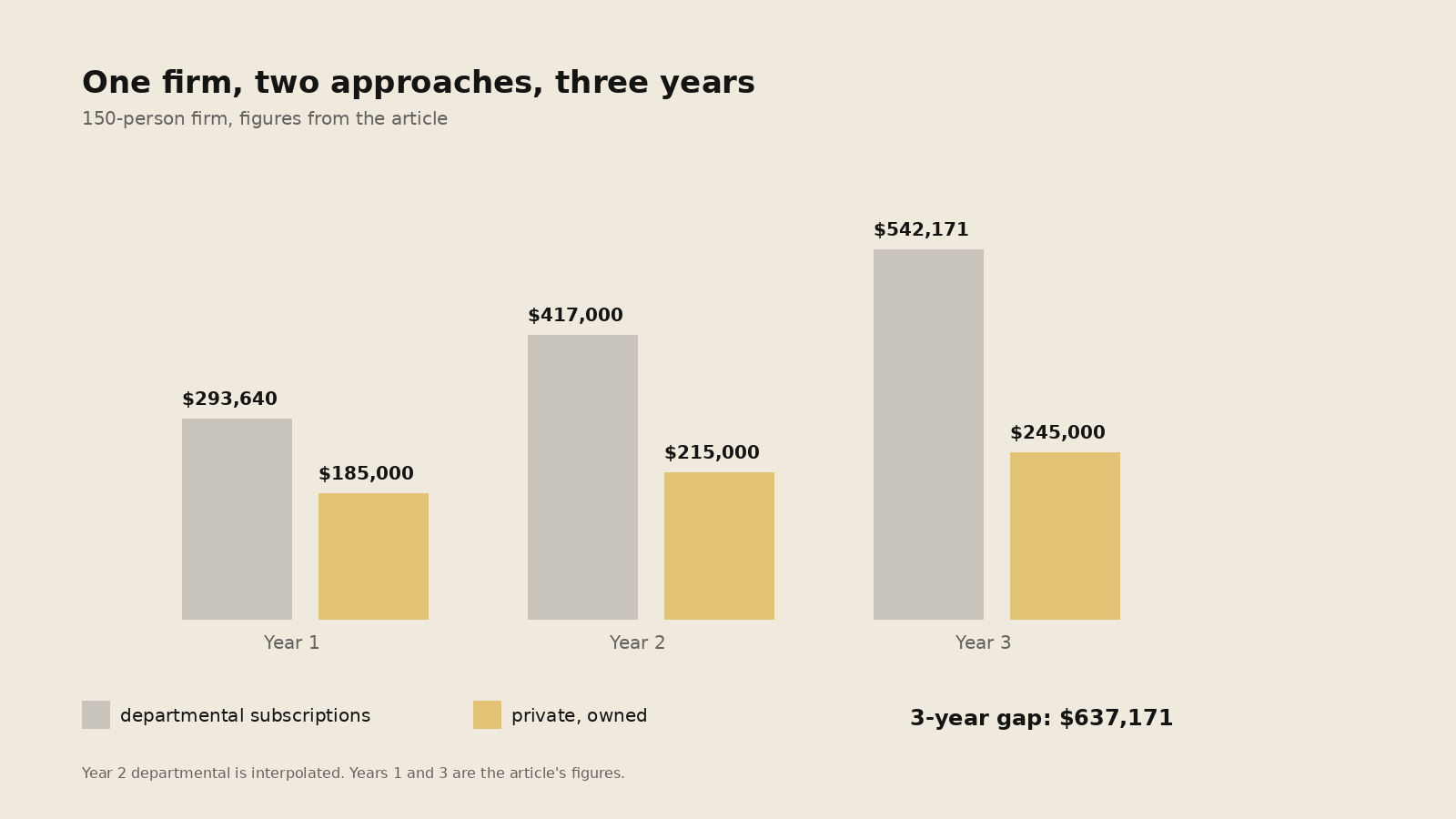
Here is the math for a 150-person wealth management firm moving from departmental subscriptions to Private AI. The figures are composited from firms that size, not one client’s books.
Before, the departmental AI approach.
-
ChatGPT Team for 50 knowledge workers: $18,000/year
-
Salesforce Einstein for CRM: $75/user/month = $135,000/year
-
Intercom with AI for client support: $99/agent/month = $35,640/year
-
Jasper for marketing content: $125/user/month = $45,000/year
-
Various integrations and middleware: $60,000/year
-
Total Year 1: $293,640
-
Projected Year 3 (with 36% inflation): $542,171
After, the Private AI approach.
-
Initial implementation (3 months): $125,000
-
Infrastructure (hosted on their cloud): $24,000/year
-
Ongoing optimization and feature additions: $36,000/year (co-creation model)
-
Total Year 1: $185,000
-
Total Year 3: $245,000 (decreasing per-user costs as system scales)
3-Year Savings: $637,171
The financial savings are the start. This is what they got.
The Real Advantages of Private AI
1. Everything Talks to Everything
Instead of five disconnected AI tools, they built one system integrated across their entire operation. When a client emails about portfolio performance, the AI does five things.
-
Pulls their complete portfolio history from the CRM
-
Analyzes current market conditions and relevant positions
-
Generates a personalized response with specific performance metrics
-
Updates the advisor’s task list if action is needed
-
Logs the interaction for compliance reporting
That workflow requires zero manual steps. With departmental tools, it would need five different logins and manual data transfer between each system.
2. It Learns Your Business, Not Generic Patterns
The AI is trained on their proprietary research, their client communication style, their investment philosophy, and their compliance requirements. When it drafts a client update, it doesn’t sound like generic ChatGPT output, it sounds like them.
IBM’s research on enterprise AI adoption found that organizations prioritizing interoperability and choice see the strongest results: 85% emphasized transparency in AI systems, and 84% stressed the need for interoperability. Private AI delivers both by default because you control the system.
3. Zero Token Waste During Implementation
A cost advantage nobody talks about. With public AI (ChatGPT Enterprise, Claude for Business), you pay tokens during the implementation phase. Every test, every iteration, every bug fix burns tokens.
Companies waste $5,000-$20,000 on tokens just trying to integrate enterprise AI subscriptions. With Private AI, implementation happens on your infrastructure at zero marginal cost. You only pay tokens when connecting to external models for specific tasks (like having a coding agent use Claude). The tokens you pay go to WORK, not to figuring things out.
4. Costs Decrease Instead of Inflate
With subscription AI, your costs increase every year. With Private AI, four things are different.
-
Per-user costs decrease as the system scales (you’re not paying per seat)
-
Infrastructure costs become more efficient as usage optimizes
-
You’re not subject to vendor price increases (you control the infrastructure)
-
Ongoing costs are predictable (no surprise consumption charges)
The wealth management firm’s Year 1 cost was $185,000. By Year 3, even with feature additions, they’re at $245,000, while their departmental AI approach would have hit $542,171. The gap widens every year.
The Implementation Reality
What implementing Private AI actually requires.
Research on mid-market AI implementation shows customized deployments typically range from $30,000-$200,000 depending on complexity. For most 100-500 employee companies, the realistic range is $100,000-$150,000 for initial implementation.
That breaks down as follows.
-
Discovery & Design (30% of timeline): Analyzing your data, mapping workflows, designing the system architecture
-
Implementation (40%): Building the AI chatbot interface, integrating with your tools, training on your data
-
Optimization (20%): Testing in live scenarios, fixing issues, ensuring stability
-
Vision & Ongoing Evolution (10% initial, then continuous): Creating agentic agents, adding features as needs evolve
Timeline. Most mid-market companies achieve full implementation in 90 days, significantly faster than enterprises that get trapped in governance committees. You’re not trying to coordinate 10,000 employees across multiple business units. You can move decisively.
The key is the co-creation model. You’re not buying a finished product that remains static. You’re building a system that evolves with you. Just like in Minecraft, once you start building your world, you get addicted to making it better. That’s why the ongoing relationship works, you WANT to keep evolving it.
What Separates Winners from Losers
McKinsey’s 2025 State of AI report identified clear patterns separating “AI high performers” (organizations achieving 5%+ EBIT impact from AI) from everyone else:
Winners do these things.
-
Redesign workflows for AI (not just bolt AI onto existing processes)
-
Establish robust talent strategies (invest in AI capabilities, not just tools)
-
Implement strong governance (trust and transparency are the license to operate)
-
Track clear KPIs (measure impact, not activity)
-
Commit significant resources (more than 20% of digital budgets to AI)
Losers make these mistakes.
-
Treat AI as a tool, not a transformation (“We bought Copilot, now we have AI”)
-
Expect immediate ROI without workflow redesign (productivity gains require process changes)
-
Lack CEO sponsorship (less than 30% have executive backing of AI agenda)
-
Skip change management (technology without adoption = zero value)
-
Measure activity instead of impact (“We deployed 15 AI models!” instead of “We reduced costs by $2.3M”)
The pattern. Companies treating AI as infrastructure (Private AI approach) vastly outperform those treating it as software subscriptions (Departmental AI approach).
Research from PYMNTS Intelligence on mid-market companies ($50M-$1B in annual sales) found that those building integrated AI systems report more visible cash positions, more accurate forecasts, and more strategic working capital use. The transformation isn’t just about productivity, it’s about making better decisions faster.
The 2026 Choice: Rent Intelligence or Own It
What the data says.
Shadow AI, 90% of workers already using it.
-
✅ Real productivity gains (40% average boost)
-
❌ Zero control or visibility
-
❌ Catastrophic data security risks
-
❌ No compounding intelligence
Departmental AI, $7.3B spent in 2025.
-
✅ Legitimate departmental gains
-
✅ Approved and managed tools
-
❌ $85,521/month average costs (growing 36% yearly)
-
❌ Fragmented, disconnected systems
-
❌ Permanent dependency (costs never decrease)
Private AI, 66% reporting significant gains.
-
✅ 1.8% annual productivity growth (compounding)
-
✅ Complete integration across business
-
✅ Learns your business specifically
-
✅ Costs decrease over time (economies of scale)
-
✅ You own the intelligence you create
-
✅ Zero token waste during implementation
-
❌ Requires upfront investment ($100K-$150K)
The question for mid-market leaders in 2026. Do you want to rent intelligence that keeps you dependent, or own intelligence that compounds?
Companies choosing Path 3 aren’t just getting ROI, they’re building competitive moats. While their competitors pay escalating subscription fees for disconnected tools, they’re operating with integrated intelligence that gets smarter every day.
EY’s research found that 56% of organizations seeing positive ROI report significant measurable improvements in overall financial performance. They’re reinvesting those gains into building more AI capabilities, not paying more subscription fees.
That’s the difference between renting and owning. When you rent, your costs compound against you. When you own, your intelligence compounds for you.
Before You Own Anything, Map It
Everything above says own it. What it does not say is how you decide what to own first.
That gap is where most Path 3 projects go wrong. A company decides to stop renting, picks the department that complains loudest, and builds there. Six months later it owns a system that automated the wrong thing, because nobody looked at how the work actually moved before choosing where to put the intelligence.
We learned this by doing it. What this article calls Private AI is what we now call building the AI version of your business, and the first step is not a build. It is a map.
Every business does three things. It gets customers, it delivers what it sold, and it keeps them. Follow one piece of work through all three, mark every place it sits waiting, and ask at each stop whether a person is meant to be there. The waits nobody can explain are where the intelligence goes. The waits someone can explain are where it does not, however much a vendor would like to sell you something for them.
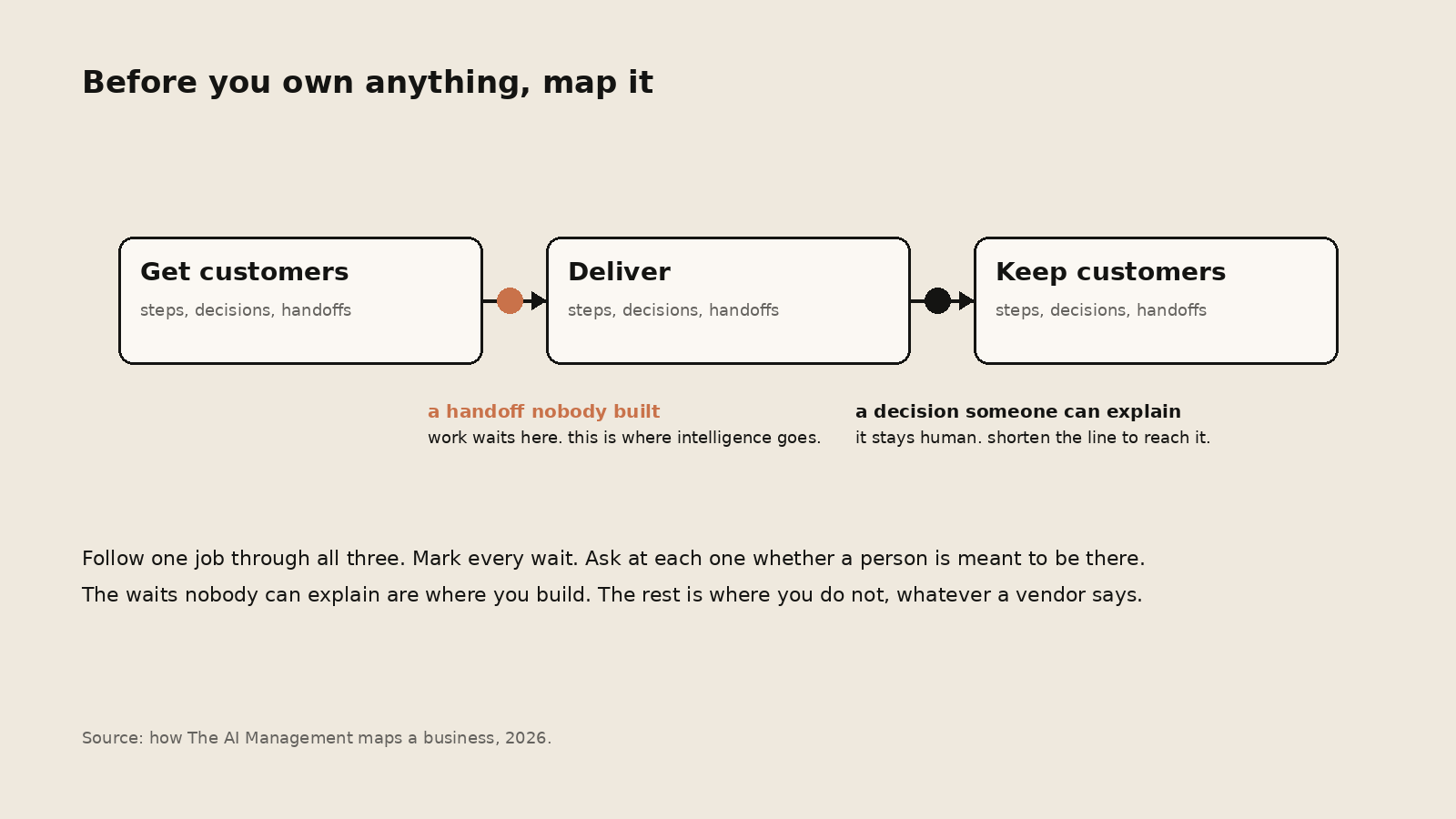
Do that once, on paper, for one job, and the Path 3 conversation changes. You are no longer choosing a department. You are choosing a specific stop in a specific line, with a number on what waits behind it. That is the difference between a system you own and a subscription you happen to host.
We map businesses this way for a living. A real one is open below, thirty-two people, forty-five steps, every handoff typed, and you can read why each AI opportunity was ranked where it was.
Open a real map before you build anything
A Blueprint of a thirty-two person company, open to anyone. Every step, every handoff, every place work waits, and the reason each AI opportunity ranked where it did.
Open a real Blueprint mapWant the map for your business?
The Blueprint follows every job through how you get customers, deliver, and keep them, from three points of view, and ranks every place intelligence belongs with the reason written next to it. Thirty days. Yours to keep, and you can build with us, your team, or anyone.
See the BlueprintNext in this series. Where should you implement AI in your business? Map first, tools later.
Frequently asked questions
How quickly can mid-market companies implement Private AI?
Research shows top-performing mid-market companies achieve full implementation in 90 days from pilot to production, according to MIT's State of AI in Business report. That breaks into four phases as we run them. Discovery and design, about 30% of the timeline. Implementation, 40%. Optimization, 20%. Vision and ongoing evolution, 10% at the start and continuous after. Unlike enterprises that spend months in governance committees, mid-market firms can move decisively, because you are coordinating 100 to 500 people, not 10,000 across multiple business units. Start with the foundation, which is automations, workflows and data ingestion. Then add the intelligence layer. Then scale.
What's the minimum viable investment for Private AI?
For companies with 100 to 500 employees, a realistic Private AI build runs $100,000 to $150,000, plus roughly $24,000 to $60,000 a year for infrastructure and ongoing optimization. Compare that to the departmental route. A 200-person company running AI tools across five departments typically spends $250,000 to $400,000 a year, and CloudZero's 2025 State of AI Costs report found average monthly AI spending rose 36% year over year. The build pays for itself inside the first year or two, through eliminated subscription costs and the $5,000 to $20,000 of token waste you avoid during implementation. The gap widens every year, because infrastructure costs do not inflate the way SaaS subscriptions do.
How do you measure Private AI ROI differently than subscription AI?
Subscription AI ROI measures a department. Did the coding assistant make developers faster? Private AI ROI measures the system. Did we redesign the workflow so the gain shows up across the company? The difference is integration. IBM's study of 3,500 executives found 66% of enterprises report significant operational productivity improvements, and the organizations seeing the strongest results are the ones that prioritized interoperability and transparency. Measure four things. Cross-functional efficiency, meaning tasks that needed three systems and now need one. Cost trajectory, whether your costs are rising or falling. Intelligence compounding, whether the system is getting better from your usage. And dependency, whether you could switch vendors tomorrow.
What happens to Shadow AI when you implement Private AI?
Shadow AI use drops when the internal system is better than the public one, and it drops for a simple reason. Employees were using ChatGPT or Claude out of necessity. MIT found workers at over 90% of companies using personal AI tools for work while only 40% of companies had bought an official subscription. They needed AI to do their jobs and nobody had given them an approved option. Deploy a system trained on their documents, integrated with their tools, that understands their workflows, and they stop using personal accounts because yours is better. You are not fighting Shadow AI with policy, you are removing the reason for it. Some personal use continues, and that is fine. The metric that matters is whether proprietary company data has stopped flowing to public platforms.
Can Private AI start small and scale, or is it all-or-nothing?
It scales in stages. Start with one high-impact department, usually operations, sales or customer success, for about three months. Prove it with concrete metrics. Time saved, costs reduced, revenue increased. Then expand to adjacent functions on the same infrastructure, where your marginal cost per additional user drops because you are not paying per seat. The 150-person firm in this article, whose figures are composited from firms that size, began with client communications and expanded from there, ending up with several times the users on infrastructure originally built for one team. That is the advantage. Scale without a proportional cost increase.
What about companies that already invested heavily in departmental AI subscriptions?
The sunk cost fallacy is real, and the math is worth doing anyway. If you are spending around $300,000 a year on fragmented subscriptions heading toward $550,000 by year three, a build at $150,000 plus $60,000 a year of ongoing cost overtakes it inside two years and keeps widening after. Most companies run a hybrid transition rather than a switch. Keep the critical subscriptions, the coding assistant your developers love, and migrate the disconnected tools into one integrated system. The pattern is to find the tools where you are paying separately for features that could be unified, migrate those first, and keep the specialized ones where a subscription genuinely earns its price.
How does Private AI handle compliance for regulated industries?
Private AI deployed on your own infrastructure gives you control over data governance, which is most of what compliance actually asks for. For HIPAA, SOC 2, GDPR or SEC requirements, the system never touches public cloud services without your explicit permission, and the data stays inside your security perimeter. In practice that means encryption at rest and in transit, full audit logging, and role-based access control, with your compliance team able to see exactly what the AI accessed and when. That is the difference from a subscription service, where you are trusting a vendor's security and cannot inspect it yourself. Control is what makes compliance provable instead of asserted.
What are the biggest implementation pitfalls to avoid?
MIT's Project NANDA studied 300 public AI deployments and found 95% of enterprise generative AI pilots produced no measurable impact on the P&L, against $30 to $40 billion invested, and the cause it identifies is a learning and workflow gap rather than model quality. Five pitfalls account for most of it. Data quality, because a system built on messy data produces messy output, so clean and structure the data before implementation rather than after. Missing executive sponsorship, and McKinsey's State of AI research found fewer than 30% of organizations have executive backing of the AI agenda. Skipping workflow redesign, because bolting AI onto a process that was already broken only makes the business inconsistent faster. No change management, since technology without adoption produces nothing. And measuring activity instead of impact. Fifteen models deployed is not a result. Define the business metric before you build, whether that is time saved, cost reduced or revenue gained, and measure that one.
Is Private AI only viable for tech-savvy companies?
No. The work is implementing and customizing a system, not building models from scratch, so what you need is someone who understands your business processes and a partner who can translate those into system design. Think of it like implementing a CRM. You do not need a software engineer on staff. Companies that do this well often have no in-house AI expertise at all, and the most technical person is whoever is good with spreadsheets. The implementation includes training your team to run the system, and most companies handle day-to-day optimization internally within a few months, calling for help when they want to add something substantial.