
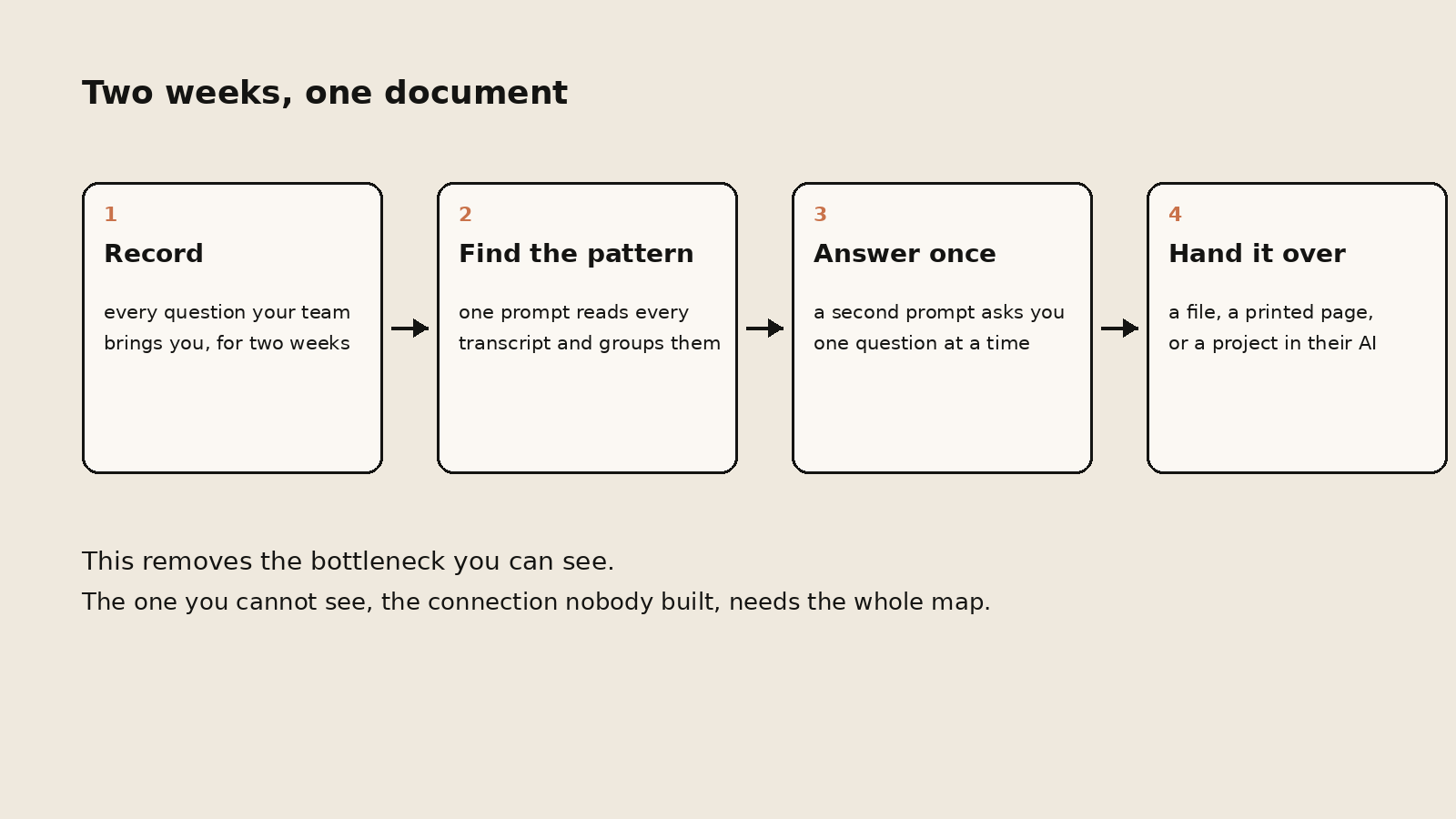
You cannot find the bottleneck in your business from your own chair, because you are the one person who does not see the queue forming behind you. Every guide tells you to track your decisions for a week. Do this instead. Record every question your team brings you for two weeks, let an AI find the patterns, answer them once, and hand the team the answers. That removes the bottleneck you can see. The one you cannot see, the handoff nobody built, only shows up when you map how the business actually runs.
Why can’t you see it yourself?
Because the queue forms behind you, and you are facing forward.
Every article on this subject starts the same way. Write down every decision you made last week. Sort it into three columns. Find the ones only you can do. It sounds right, and it is the wrong starting point, because the list you write is the shortest one in the building.
We mapped a technical services company with thirty-two people. Three engines, forty-five steps, every handoff. The company is a composite built from thirty real ones we mapped, and every quote below is in the map. We asked the owner who reviews work before it goes to a client. “The significant ones. Anything going to a client that matters.” We asked his operations manager. “He reviews everything.” We asked the coordinator who sends the work. “Everything. I’ve never sent something out that he didn’t look at. Not once in four years.”
Then we asked how long a review waits. The owner said a day, maybe. Later in the same conversation he counted what was on his desk. Two reviews. One since yesterday. One since Friday.
“It’s been a week.”
He was not lying. He was answering from his chair. From his chair, a review is an hour of his attention. From everyone else’s chair, it is a week of waiting. If he had done the track-your-decisions exercise, he would have written down the hour.
What is the one question that finds it?
If you disappeared for two weeks, no phone, what breaks first?
We asked that owner. He answered before the question was finished. “Deliverables stop going out. Because they’d all be sitting waiting for me.”
One sentence. The bottleneck named itself, and it was the thing he had just said only applied to the significant ones.
Ask yourself that question. Then ask your manager the same one, separately, and ask the person who does the day-to-day work. If the three answers match, you already knew. If they do not match, the gap between them is where the work is stopping.
Should every bottleneck go?
No, and this is where the advice you will read elsewhere gets dangerous.
The guides say extract yourself from everything. But a bottleneck is one of two things, and they need opposite fixes.
Some are there on purpose. That owner’s review catches one deliverable in eight, and it is always something that would have embarrassed the company. A client’s old name after a rebrand. An assumption the client would not understand. His operations manager, asked whether the review should exist, said “Yes. Absolutely yes.” That is a gate. A person is there because a decision needs making, and someone can say what the decision is. You keep it. What you fix is how long the work waits to reach it.
Some are there by accident. In the same company, the operations manager learns a deal closed when the sales lead mentions it in the hallway. He turned off his CRM notifications a year ago. He has found out three or four days late, and by then the crew’s open slot is gone and the client waits an extra week. That is a gap. Nobody decided a person should be there. The connection was never built. You remove it.
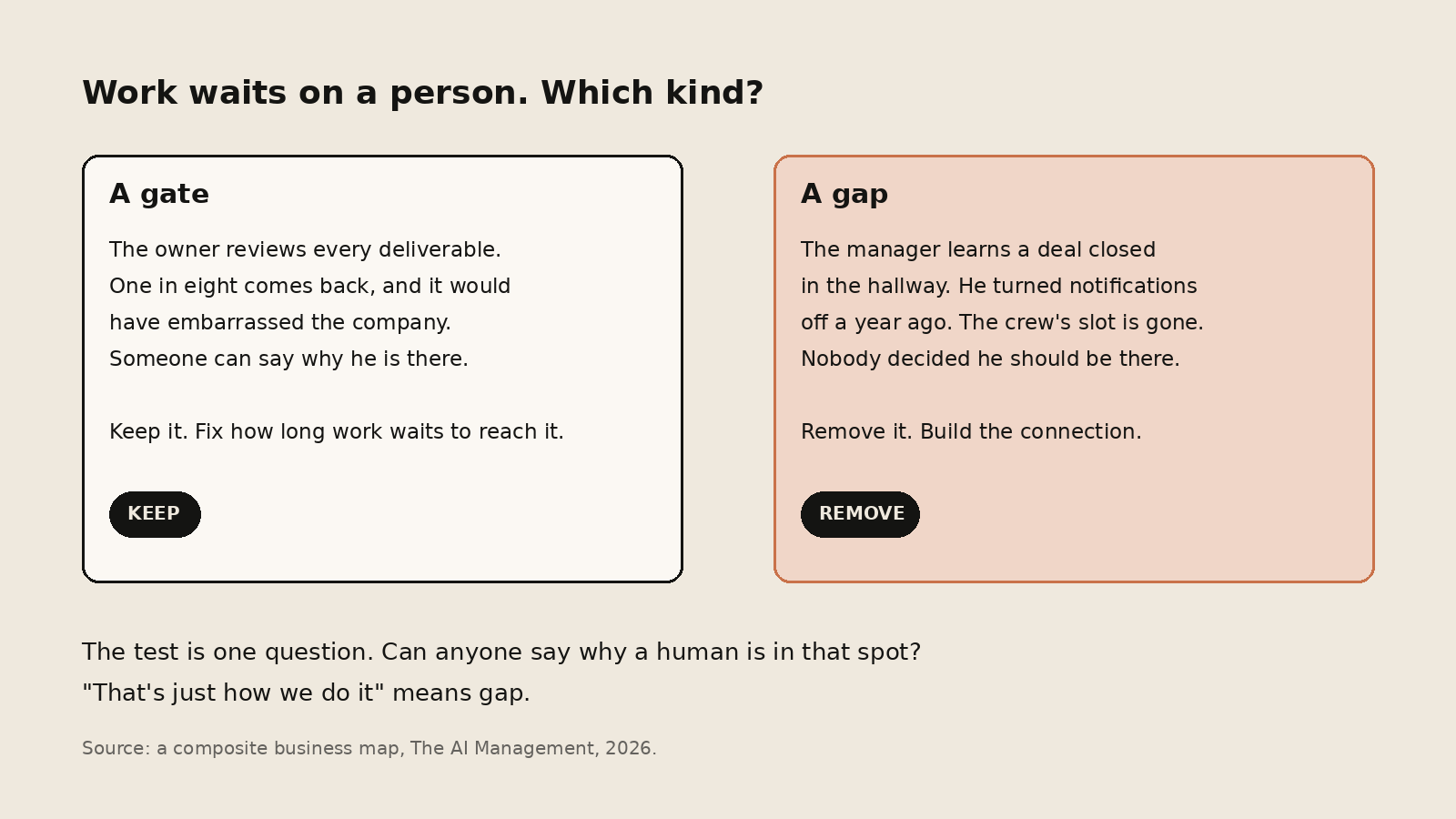
The test is one question. Can anyone say why a human is in that spot? If the answer is “that’s just how we do it,” it is a gap.
See what a whole map looks like
A real Blueprint of a thirty-two person company, open to anyone. Click the owner's review and read the three answers. Then find the handoff nobody built.
Open a real Blueprint mapRecord the questions for two weeks
Here is what to do instead of tracking your decisions from memory.
Tell your team that for the next two weeks, every time someone comes to you with a question, you are going to record it. Say why. You want to find out what they keep needing from you, so you can write it down once. People are fine with this when they know the reason, and most of them are relieved.
Then record every one. A meeting recorder on your phone or laptop is enough. We use Granola for every interview we run, and it works for a two-minute hallway question as well as an hour-long call. If a question comes in over WhatsApp, screenshot it into the same folder.
Do not answer differently than you normally would. The point is not to be better for two weeks. The point is to capture what actually happens.
At the end of two weeks you will have somewhere between thirty and two hundred recordings, and you will already have noticed that the same five questions keep coming back with different names on them.
Turn the questions into answers
Now the AI does the part it is actually good at. Reading two hundred transcripts and finding the pattern.
If your recorder connects to Claude or ChatGPT, connect it. If it does not, export the transcripts and upload them. Then use this.
I run a business. Attached are two weeks of recordings of questions my team brought to me. Read all of them. Then give me a list of the distinct questions people were actually asking, grouped so that questions with different wording but the same need are one line. For each line, tell me how many times it came up, who tends to ask it, and what I usually answered. Order the list by how often it came up. Do not summarize. Do not add advice. Just the list.
You will get a list. It will be shorter than you expect, and the top five will cover most of the two weeks.
Now the second prompt, which turns the list into answers. The trick is one question at a time, because if you try to write the whole thing at once you will write the version from your chair again.
Take the list you just made. Starting with the most common question, ask me one question at a time to get the answer my team needs. Ask a follow-up if my answer has a hole in it, like a threshold I have not stated or a case I have not covered. When one question is fully answered, write the answer in plain language a new employee could follow without asking me, and move to the next. When we have covered every question on the list, give me the whole thing as a document titled "Questions I ask my boss."
Twenty minutes of answering, and you have a document that did not exist before.
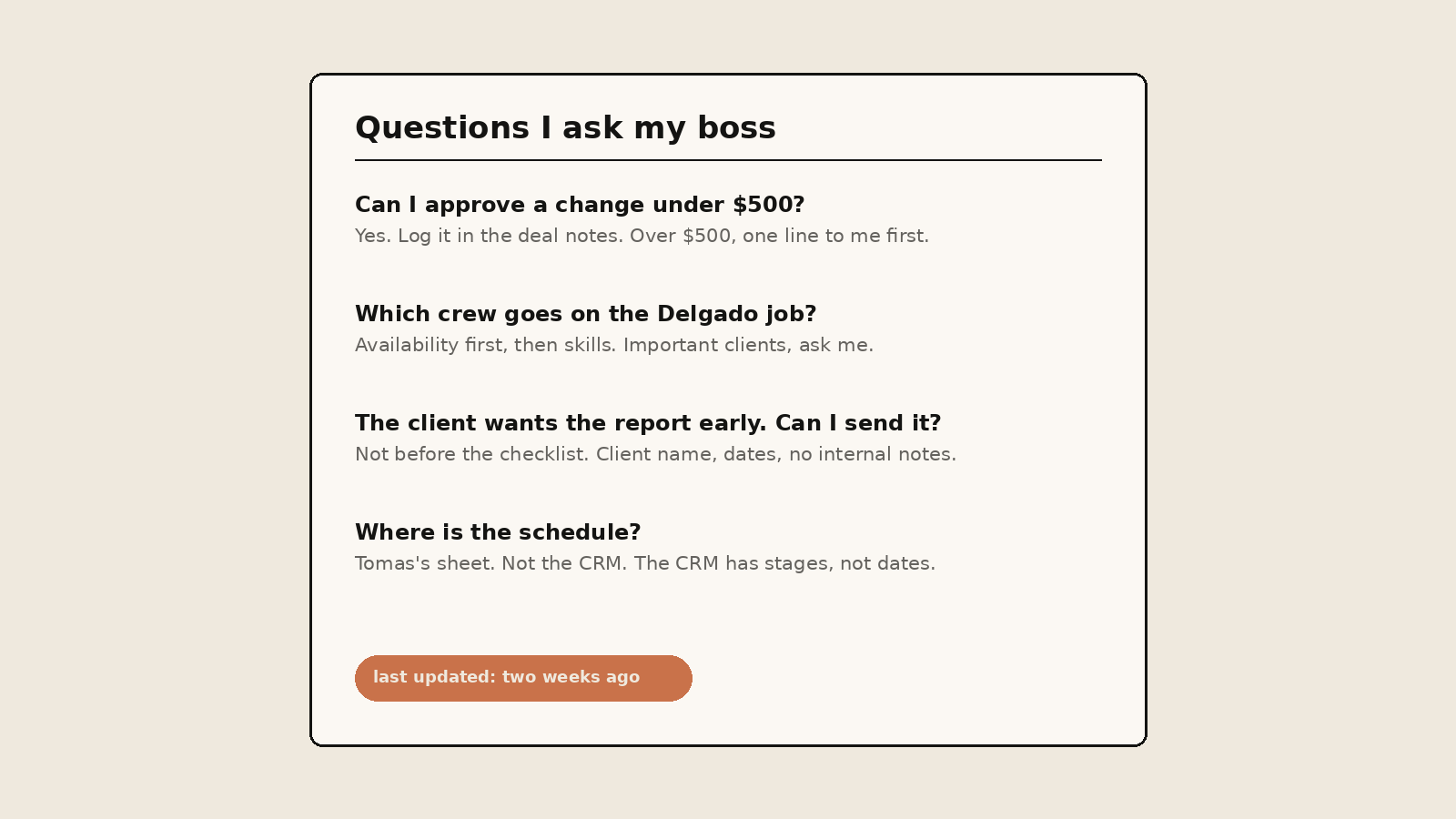
Give it to the team however they will actually read it. A file, a printed page on the wall, or a shared project inside whatever AI tool they already use, with the document loaded and named so they can ask it instead of asking you.
What this fixes, and what it cannot
This fixes the bottleneck you can see. The questions that came to you because the answer lived only in your head. Two weeks of recordings and one document, and a real share of your interruptions stop.
It cannot fix the one you cannot see.
In that same company, the owner said the standard for good work could not be written down. “That’s looking at something and knowing whether it’s right.” His coordinator had a private list of nine or ten things the owner sends back, built from four years of watching. Since he started using it, send-backs fell from one in four to one in eight. The owner did not know it existed. No amount of recording the owner’s own answers would have found that list, because the owner never asked the question it answers.
And the manager who finds out about closed deals in the hallway is not asking anyone a question. He is waiting, and nobody knows he is waiting, because the wait is invisible from every chair but his.
That is the difference between a bottleneck and a disconnection. A bottleneck is a person who gets asked too much. A disconnection is two people who should be connected and are not, and neither of them can see it because each one only sees their own side.
The questions document finds the first kind. Finding the second kind means mapping how the work actually moves, step by step, from three points of view, and looking at where it stops. That is what a Blueprint is. The recording method above is the same idea at the size you can do yourself this month.
What to do this week
- Ask yourself, your manager and one person who does the daily work, separately, what breaks first if you vanished for two weeks. Write down all three answers.
- Tell the team you are recording questions for two weeks, and why.
- Set up the recorder. Phone or laptop, whatever you will actually use.
- On day fifteen, run the first prompt.
- Run the second prompt in one sitting.
- Give the team the document in the place they will read it.
Do not skip step one. It is the only one that shows you whether the bottleneck you are about to fix is the one that matters.
Ready to see the part you cannot see from your chair?
The Blueprint maps how your business actually runs, from three points of view, and marks every place work waits and why. Thirty days, and everything in it is yours.
See the BlueprintNext in this series. Where should you implement AI in your business? Map first, tools later.
Frequently asked questions
How do I know if I am the bottleneck in my business?
Ask yourself, your manager and one person who does the daily work, separately, what breaks first if you disappeared for two weeks. If the three answers match, you already knew. If they differ, the gap between them is where work is stopping. Your own answer alone is the least reliable of the three.
Why does tracking my own decisions for a week not work?
Because you count the minutes a decision takes you and not the days it waits before it reaches you. In one business we mapped, the owner said a review waits about a day. When he counted his own pile, one had been there a week. From his chair it was an hour of work. From everyone else's it was a week of waiting.
Should I remove every bottleneck?
No. Some are there on purpose. If someone can say what decision is being made at that spot and why it needs a person, it is a gate. Keep it and shorten the wait to reach it. If nobody can say why a person is there, it is a gap. Remove it by building the connection that was never built.
What is the fastest way to stop my team asking me the same questions?
Record every question they bring you for two weeks. Give the transcripts to Claude or ChatGPT and ask for the distinct questions grouped by need and ordered by frequency. Then have the AI ask you one question at a time until each is fully answered, and give the team the resulting document.
What should the questions document be called and where should it live?
Call it something like Questions I ask my boss. Put it where the team will actually read it, which is usually a printed page, a shared file, or a project inside the AI tool they already use, loaded so they can ask it instead of asking you.
What can the questions document not fix?
The bottleneck you cannot see. A manager waiting on a notification nobody set up is not asking anyone a question, so no recording catches it. Finding that kind takes mapping how work actually moves between people, from more than one point of view. That is what a Blueprint does.