
A new website will not hurt your Google rankings if the addresses that bring you visitors are kept or redirected one to one, the content that ranks stays, and nothing on the new site tells Google to stay out. Google's own guidance is to expect a few weeks of movement while it reindexes, not a loss. The part nobody tells you is that a rebuild is now two tests. Google runs your site's code before reading it. ChatGPT, Claude and Perplexity do not, so a rebuild can keep every Google ranking and still be blank to the assistants your customers ask.
Why does a new website sometimes drop in Google?
Because something that used to be there is gone, and Google noticed before you did.
You know the story. A business has a site from 2017. Ugly, slow, but it ranks. They pay for a new one. It launches on a Friday. By the following Thursday the phone is quieter, and by the end of the month someone opens Search Console and the line has fallen off a cliff.
The designer says rankings always dip after a redesign. That is half true and fully useless.
Rankings drop after a rebuild for three reasons, and all three are avoidable.
The first is addresses. Your old site had a page at /services/roof-repair. The new one has it at /roofing. To you it is the same page. To Google it is a new page with no history and an old page that vanished. Every link anyone ever made to the old address now points at nothing.
The second is content. Your old service page had six paragraphs and a list of the neighborhoods you work in. The new one has a hero image and two sentences, because the designer said less is more. Less is more for design. It is not more for a search engine deciding whether you do roof repair in Hialeah.
The third is a switch. Every site under construction carries a setting that tells Google not to index it. That switch has to be turned off when the site goes live. Sometimes it is not. The site looks perfect, and Google has been told to leave.
Fix those three and the drop does not happen. Everything else in this article is how.
Is it true that 301 redirects lose 15 percent of your ranking?
No. That number is from 2013, and Google retired it in 2016.
You will still read it on page one for this exact question. One of the top results says a redirect costs you “about 15 percent” and links a video from a decade ago. In July 2016 Google’s Gary Illyes said, in seven words, that 30x redirects don’t lose PageRank anymore. John Mueller confirmed it the same year. Google’s own page on moving a site with URL changes says the same.
So a redirect from the old address to the new one passes the full value. The damage comes from the missing redirect, the redirect to the wrong page, and the chain of three redirects where one would do. And the missing one costs you more with AI than with Google. In the same Vercel and MERJ data, GPTBot spent 35 percent of its visits landing on pages that no longer exist, against 8 percent for Googlebot. An old address with no redirect is a dead end a third of the time for the crawler you most need to reach you.
One old page to one new page. Every time. That is the whole rule.
What actually kills a small business rebuild?
The switch. Not the redirects, not the design. The noindex setting that was correct on the test site and never got turned off.
We know because it nearly got us.
Our own build has a guard. It is a short list of pages that must never be indexed, and if any of them shows up in the file we publish for AI readers, the build fails on purpose. When we rebuilt /first-step, that page went from a hidden landing page to a public one. The guard still had it on the list. The build refused to run, and the builder found out why in about a minute.
That is the good version of the story. The normal version is that nobody built a guard, the setting rides along from the test site to the live site, and Google does exactly what it was told. Two of the five pages ranking for this question mention that setting, in one sentence each. Neither says it is the single most common way a rebuild goes wrong for a business with no SEO team. It is.
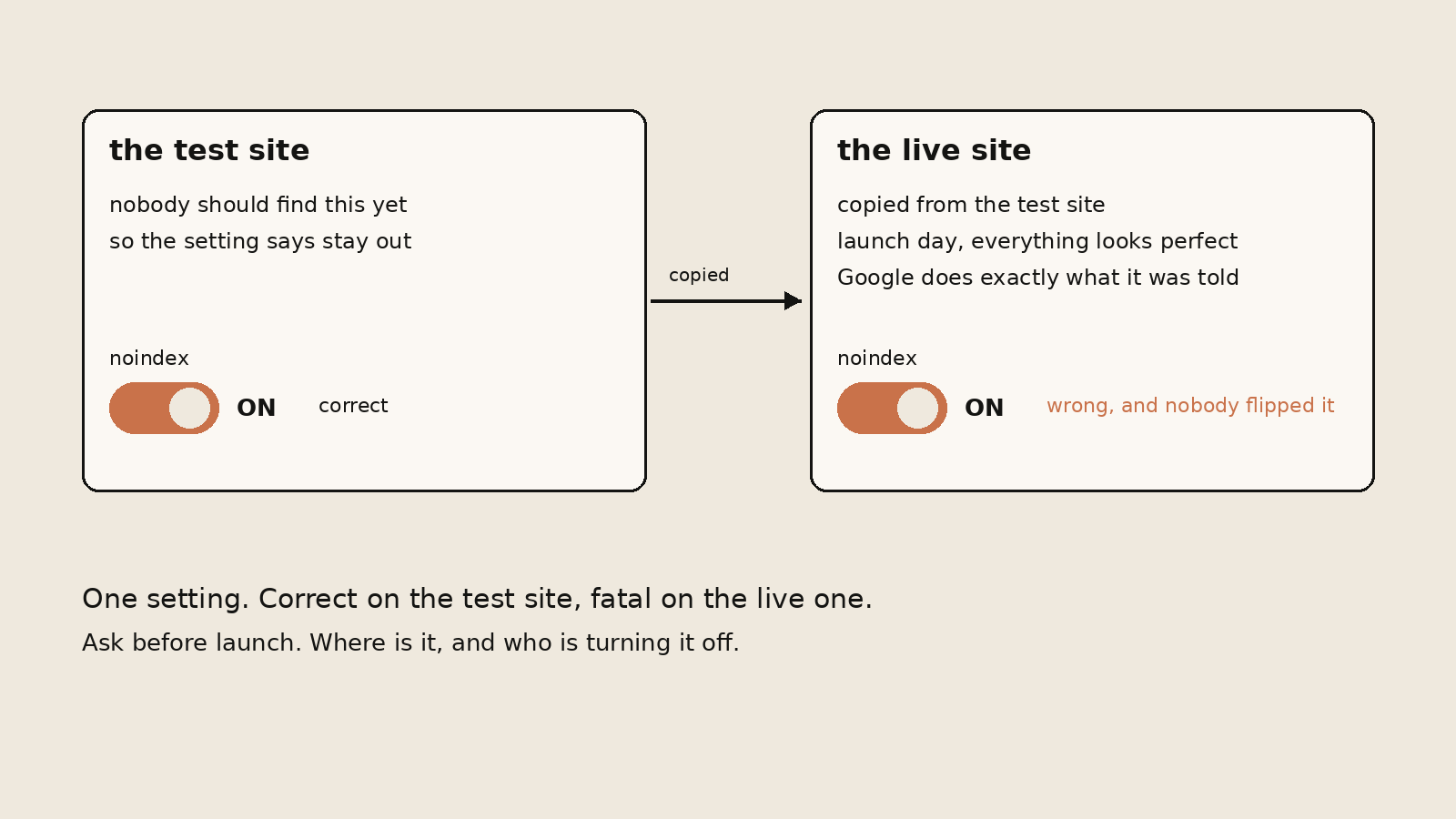
Ask your developer one question before launch. Where is the noindex setting, and who is turning it off. If they have to look it up, you have found your problem before Google did.
Will the new site pass the test Google is not running?
This is the part none of the guides ranking for this question mention, and it is the part that matters most for the next five years.
Google reads your website the way a person does. It loads the page, runs the code, waits for everything to appear, and then reads what is there. Google spent about a decade building that ability.
The AI assistants your customers now ask did not. Vercel and MERJ measured hundreds of millions of real crawler visits and found that GPTBot, ClaudeBot and PerplexityBot execute zero JavaScript. They download the code files. They never run them. They read whatever text is in the page before any script does anything.
Most websites built in the last five years are applications. The text arrives after the code runs. Google is fine with that. ChatGPT sees a blank page with a menu.
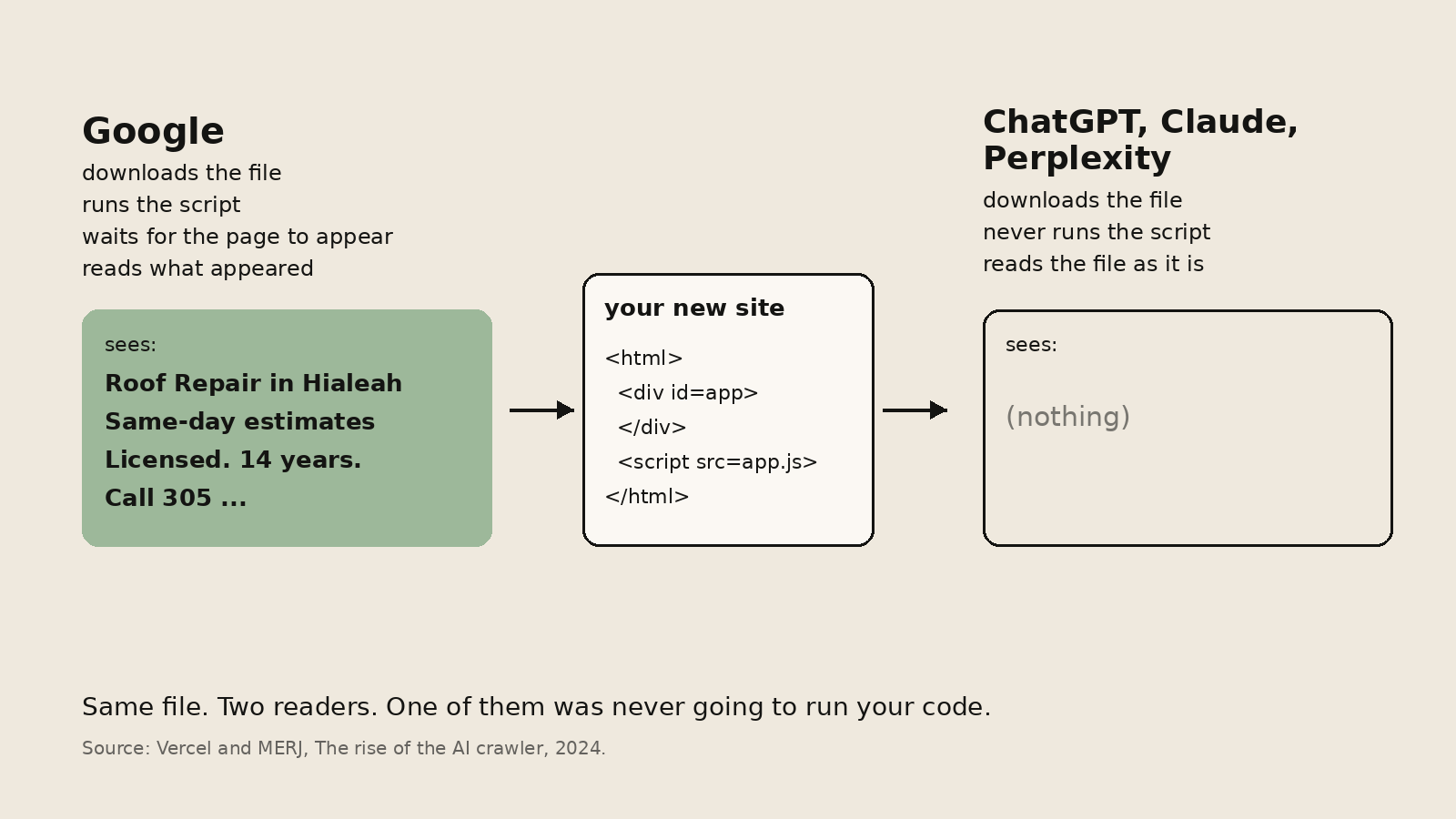
A rebuild is the one moment you get to choose which kind of site you are building. A designer who keeps your Google rankings and hands you a JavaScript app has passed the old test and failed the new one, and you will not find out until you ask ChatGPT for a roofer in your own city and it names someone else.
The test takes ten seconds. Turn JavaScript off in your browser and load the new site. If the page is complete, you pass. If it is blank, or half there, that is what every AI assistant sees.
We run that test on every site before anything else, and if it fails, the build fails. It is the first gate, not the last.
Want the rebuild done this way?
Every page that earns you visitors kept or redirected one to one, the noindex setting checked before launch, and the whole site tested with JavaScript off before anything else is looked at. That is what the First Step is.
See what the rebuild protectsWhat does the dip actually look like, and how long does it last?
A few weeks of movement, then a climb, if the three things above are right.
Google’s own guidance on site moves says to expect temporary ranking fluctuations while it reindexes moved pages. It does not say to expect a loss. The pages ranking for this question quote figures like “5 to 7 percent for a few weeks” without a source, or “80 to 90 percent preserved” from a vendor study. Treat both as folklore. The honest answer is that a correct rebuild moves around for a while and then settles higher, because the new site is faster and cleaner than the old one, and an incorrect rebuild drops and stays down until someone finds the switch.
Ours settled higher. We rebuilt our own site the way this article describes, after eight months of no AI being able to find us at all. Over the six months that followed, indexed pages went from 13 to 33, impressions from 3,190 to 11,500, and Bing went from zero to 302. Those are our Search Console and Bing Webmaster numbers, and they are on our First Step page with the screenshots.
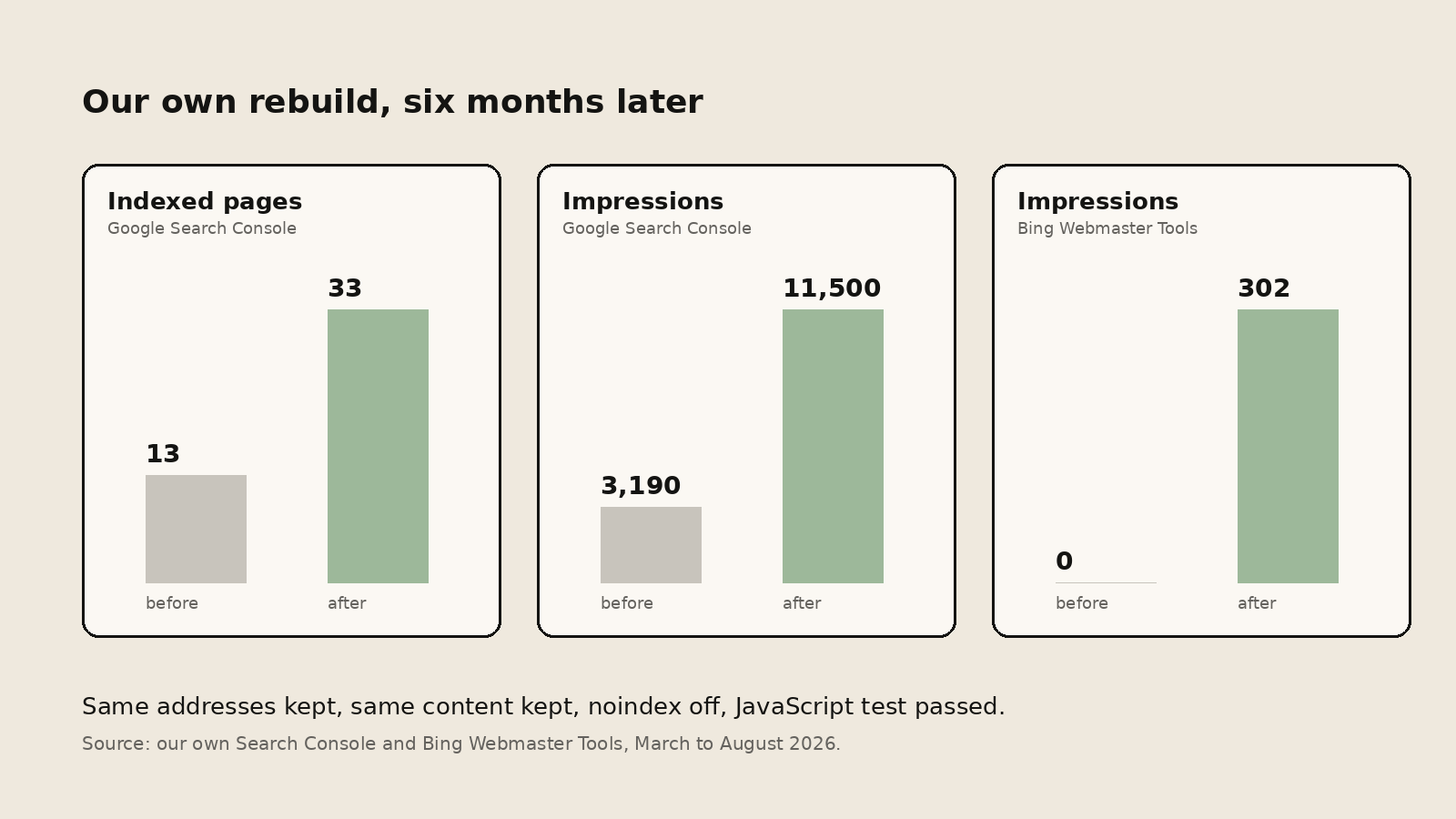
Nothing about that was luck. The addresses were kept, the content was kept, the switch was off, and the site passed the JavaScript test.
What about my Google Business Profile?
It has to agree with the new site, and nobody building your website is thinking about it.
Your profile links to your website. If that link changes, update it the day the site goes live. Your profile carries your name, address, phone and hours. The new site carries them too. If the two disagree, even by a suite number or a phone format, the picture an AI builds of your business has a crack in it, and a business with a crack loses to one without.
On the sites we build, your phone number lives in exactly one place, and the header, footer, contact page and structured data all read from it. That is what “three sources agreeing” actually requires.
What to do this week
You do not need to understand any of this to protect yourself. You need to ask for six things and check two.
Before launch, ask your developer for six things.
- A list of every page on the old site that gets visitors, from Search Console. That list is what you are protecting.
- A redirect map. Old address on the left, new address on the right, one to one, for every page on that list.
- The content from every ranking page, carried over, not summarized.
- Where the noindex setting lives, and who is turning it off on launch day.
- A sitemap submitted to Google Search Console and Bing Webmaster Tools the day the site is live.
- Your name, address, phone and hours on the new site, matching your Google Business Profile exactly.
After launch, check two things yourself.
- Turn JavaScript off and load the homepage and one service page. Complete, or blank?
- Open Search Console once a day for two weeks. Movement is normal. A cliff on day three means the switch.
If the developer cannot produce items one and two, you do not have a rebuild. You have a redesign, and those are the ones that drop.
Should you rebuild at all?
Yes, if your site cannot pass the JavaScript test, because that is not a ranking problem you can fix in place. And yes, if the old site is a page nobody can read on a phone.
No, if your site is fine and the phone is quiet for a different reason. Sometimes the answer is your reviews, or your profile, or the fact that your best service has no page of its own. A rebuild does not fix any of those, and anyone who sells you one without checking is selling you a website.
The rebuild is not the risk. The redesign is. The difference is whether someone kept the list.
Ready to rebuild without losing what you have?
The First Step is a rebuild that keeps your addresses, keeps your content, and passes both tests before it ships. Seven business days, registered in your name.
See the First StepNext in this series. This is the last article in the series. The rebuild it describes is the First Step.
Frequently asked questions
Will a new website hurt my Google rankings?
No, if the addresses that bring you visitors are kept or redirected one to one, the content that ranks is carried over, and the noindex setting is off at launch. Expect some movement for a few weeks while Google reindexes. A drop that stays is a sign one of those three is wrong.
Do 301 redirects lose ranking value?
No. Google said in 2016 that 30x redirects no longer lose PageRank, and its own guidance on moving a site repeats it. The 15 percent figure still quoted online is from 2013. What loses value is a missing redirect, a redirect to the wrong page, or a chain of redirects where one would do.
How long does it take rankings to recover after a redesign?
Google says to expect temporary fluctuations while it reindexes moved pages, usually a few weeks. A correct rebuild settles and often climbs. Our own rebuild went from 13 to 33 indexed pages and more than tripled impressions over six months.
Why did my rankings drop right after launching my new site?
The three usual causes are changed addresses without redirects, ranking content that was cut or shortened, and a noindex setting carried over from the test site. Check Search Console for crawl errors, and ask your developer where the noindex setting is and whether it was turned off.
Can a new website rank on Google and still not show up in ChatGPT?
Yes. Google runs your site's code before reading it. ChatGPT, Claude and Perplexity do not, so a site built as a JavaScript app can rank on Google and be blank to AI assistants. Turn JavaScript off in your browser and load the site. What you see is what they see.
Do I need to update my Google Business Profile when I launch a new website?
Yes. Update the website link the day the site goes live, and make sure the name, address, phone and hours on the new site match the profile exactly. When the two disagree, the picture an AI builds of your business has a gap in it.
Should I rebuild my website or just fix the old one?
Rebuild if the old site cannot pass the JavaScript test or cannot be read on a phone, because those cannot be fixed in place. If the site is fine and the phone is quiet for another reason, like reviews or a missing service page, a rebuild will not fix it.