
You cannot pick what to automate first from a list, because the list does not know your business. Follow one piece of work from the moment it enters to the moment it leaves, and mark every place it sits waiting. At each stop, ask one question. Is this wait on purpose? If someone can say why a person needs to be there, keep it. If nobody can, that is your first automation. In a business we mapped, this put a three-hour task ahead of a ten-hour one, because the three-hour task sat in front of a wait that reached nine days.
Why the lists do not work
Every guide for this question gives you a list. Invoices, reminders, scheduling, routine replies. Then a rule. Pick the one that happens most often and needs the least judgment.
The list is not wrong. It is just not yours.
The best of those guides says a task that happens fifty times a week and saves five minutes each time beats a task that happens twice a month and saves an hour. Ten hours against two. Pick the ten. That is the rule every one of them uses, in one form or another. Rank by hours saved.
It sounds like arithmetic, and it is missing the thing that actually costs you money.
A task in your business is a step in a line, and the line is what costs you. Work comes in somewhere, moves from person to person, and leaves. A step costs two things. The time the person spends on it, and the time everything behind it sits still.
You cannot see that on a list. You can only see it by following the line.
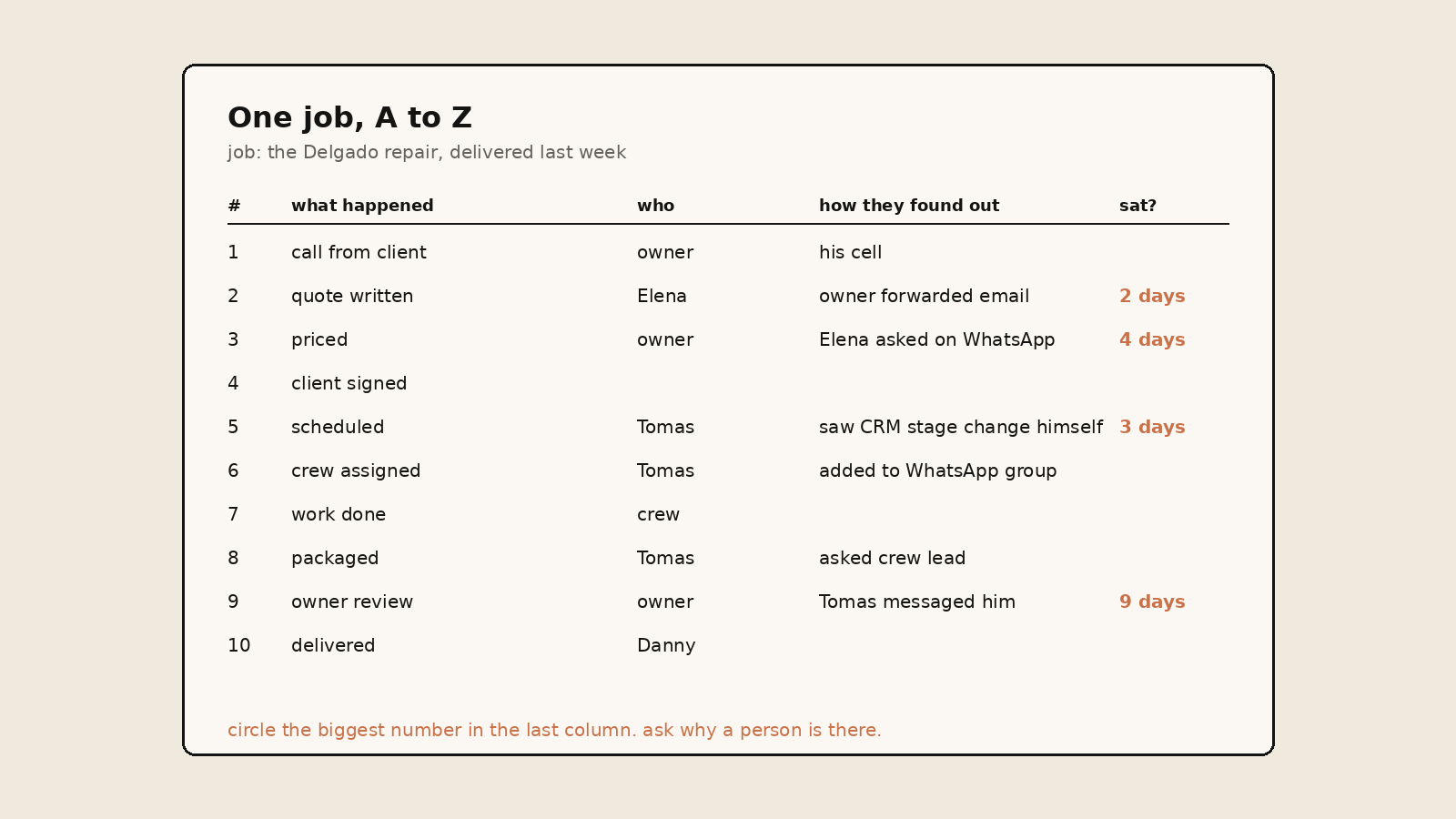
Follow one job from A to Z
Before you decide what to automate, do this once, on paper, for one real job.
Pick something that went through your business last week. A quote, an order, a project, a repair. Start at the moment it arrived. A phone call, a form, an email to you. Write that down as step one.
Then ask, what happened next? Who touched it, in what tool, and how did the next person find out it was their turn?
Write that down. Ask again. Keep asking until the job is done and the customer has what they paid for. You will end up with somewhere between eight and twenty steps, and you will have written down things you did not know happened, because you only ever see your own steps.
Now go back over the line and mark every place the work sat still, waiting for someone to pick it up. Working on it does not count. Waiting does.
Those marks are the only thing on the page that matters.
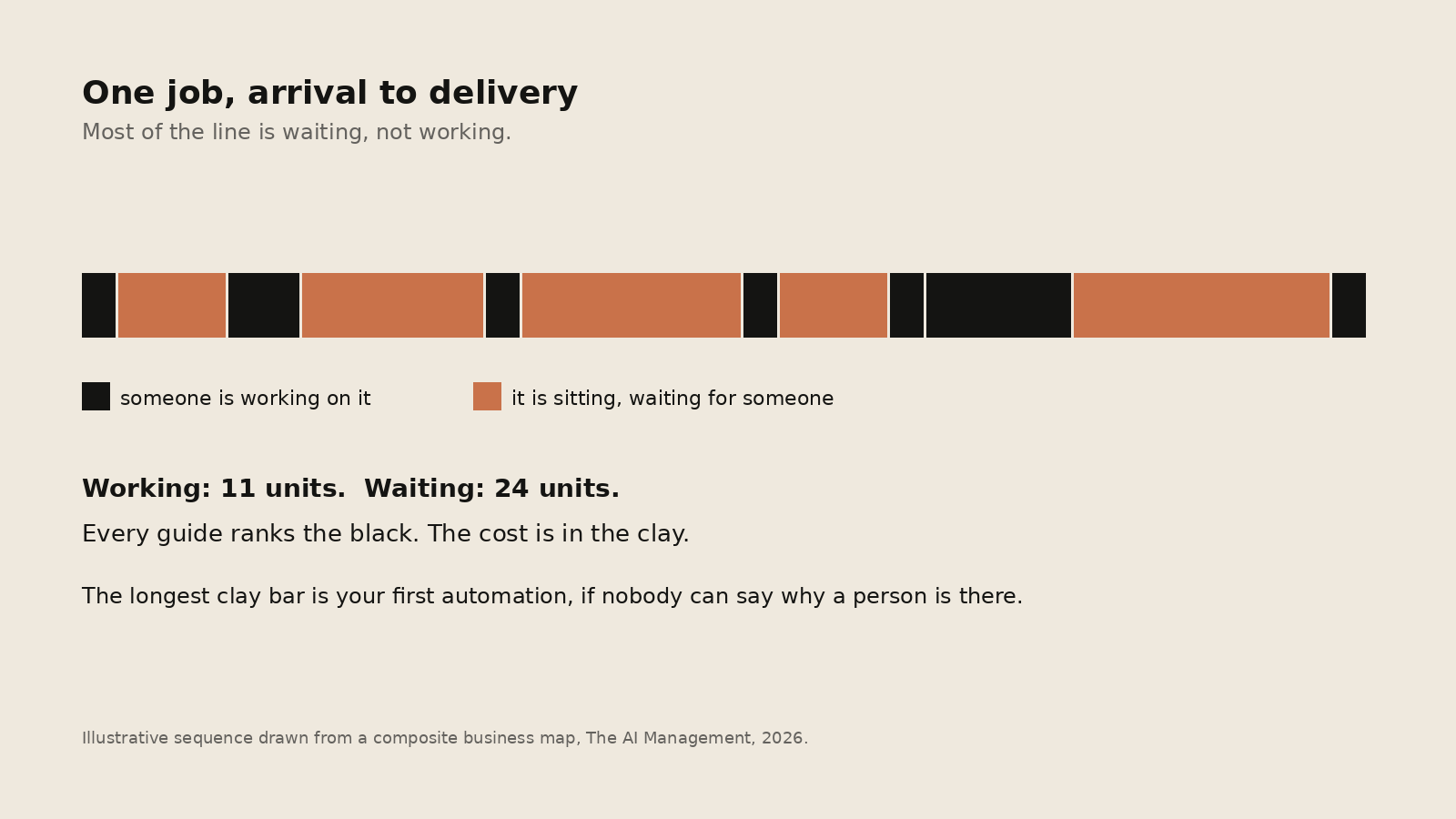
Is the wait on purpose?
At every place the work sat, ask one question. Is a person supposed to be here?
There are two answers, and they need opposite fixes.
Sometimes yes. The owner reviews every quote over a certain size because he has seen what happens when the wrong number goes out. A person is there because a decision is being made, and someone can say what the decision is. That wait is on purpose. You do not automate it. You shorten the line to reach it.
Sometimes no. The job sat for three days because the person who needed it did not know it was ready. Nobody decided that. Nobody built the connection. The work was waiting on a notification that does not exist, or on someone remembering to check. That wait is an accident.
The test is whether anyone can tell you why a human is at that spot. “That’s just how we’ve always done it” is a gap with a habit on top of it.
Your first automation is the accidental wait with the most work stacked behind it. The stop with the longest line, whatever the hours say.
Why the map picked the smaller task
We mapped a technical services company. Thirty-two people, three engines, forty-five steps, every handoff. The company is a composite built from thirty real businesses we mapped, and every number here is in the map.
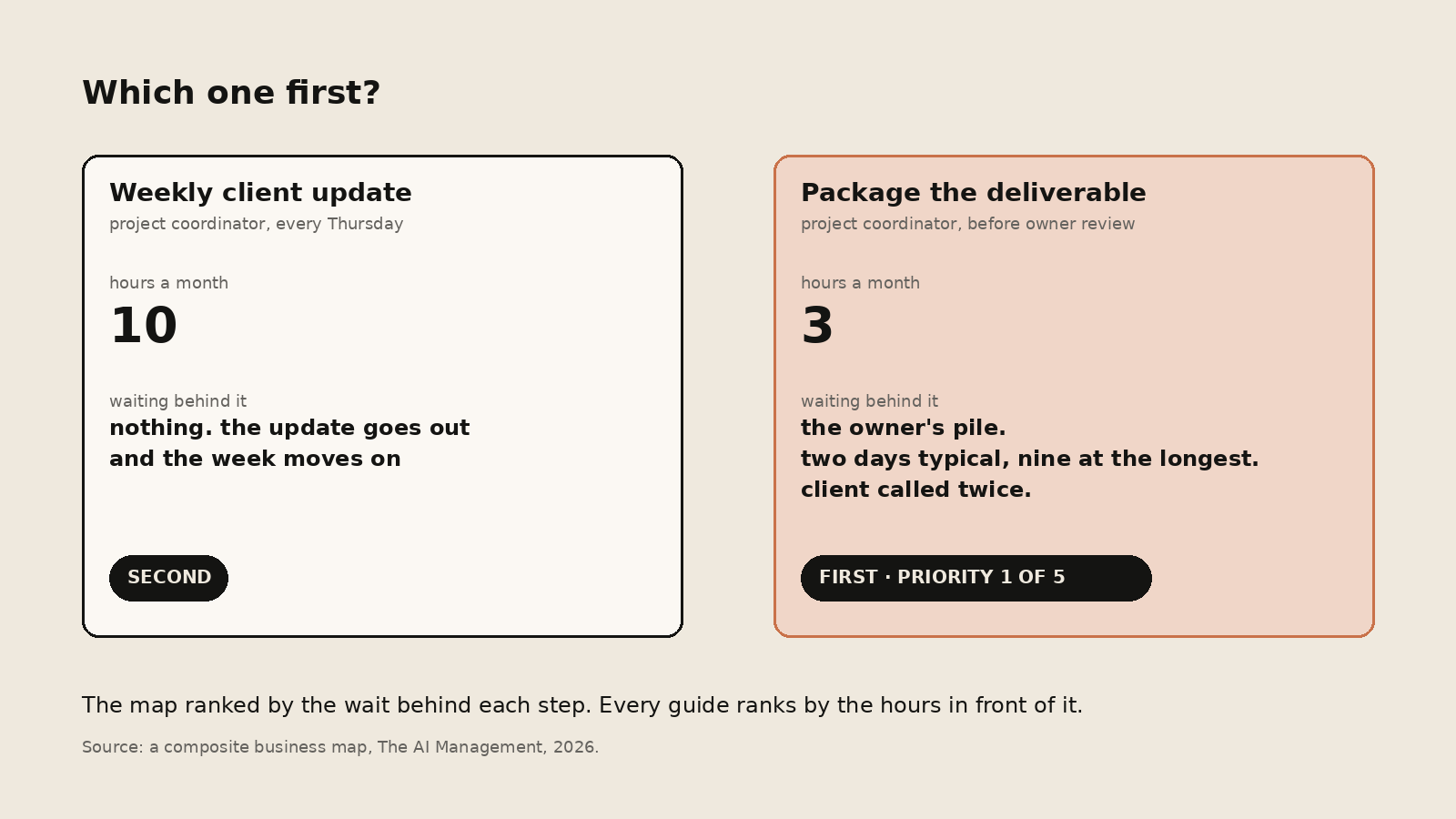
The task every guide would pick is the weekly client update. The project coordinator writes it every Thursday for six or seven live projects. For each one he opens his schedule sheet, scrolls back through the project’s WhatsApp group, listens to the crews’ voice notes and types out what they said, then checks the CRM in case something was logged there. About ten hours a month. The information already exists in three places and a person carries it between them. Frequent, repetitive, no judgment. It is on the list.
The operations manager, asked what he would automate first, picked it too. “Tomás spending hours a week assembling information that already exists in three systems. That’s just tax.”
The map marked it as an AI opportunity. And it put it second.
First was a step called Package the deliverable. About three hours a month. Before a finished job goes to the client, the coordinator packages it, runs it against a checklist, and sends it to the owner for review.
Three hours against ten. Why first?
Because of what is behind it. The owner reviews every deliverable. He said it takes a day. His coordinator said two days typical, nine at the longest, and during the nine-day wait the client called twice asking where it was. The work was done. It was sitting in a pile.
That review is a wait on purpose. The owner catches one deliverable in eight, and it is always something that would have embarrassed the company. It stays. What the map could change was how much reached him unfinished. The coordinator already kept a private list of nine or ten things the owner sends back, built from four years of watching. Since he started using it, send-backs had fallen from one in four to one in eight. The owner did not know the list existed.
So the first automation was finishing that list and having it applied before anything reached the pile, ahead of the ten-hour task. Three hours of packaging, in front of a line that reached nine days. The measurable outcome is written on the step in the map. The send-back rate and the wait. Not the hours.
See the map that made this call
A real Blueprint of a thirty-two person company, open to anyone. Find the weekly update, find Package the deliverable, and read why the three-hour step came first.
Open a real Blueprint mapWhat this changes about the list
Every task on every list is real. Invoices do get sent late. Reminders do get forgotten. Follow the line and you will probably find some of them on it.
But the list ranks them by the minutes in front of each one. The line ranks them by the wait behind each one. Those are different orders, and only the second one tells you where the business is actually stuck.
The guides also say fix the process before you automate it, and they are right. What they do not say is how you find out what the process is. You cannot, from your chair. In that company the process for a good deliverable was in a coordinator’s private notes, and the owner had said it could not be written down. Following the line from three points of view is how it turned up.
What to do this week
- Pick one job that finished last week. Write every step from arrival to delivery, one line each, with who did it and in what tool.
- Ask the person who did each step how they found out it was their turn. Write that down too. That is the handoff.
- Mark every place the work sat waiting.
- At each mark, ask whether anyone can say why a person is there. Write “on purpose” or “nobody built it.”
- Of the “nobody built it” marks, find the one with the most work stacked behind it. That is first.
- Only then look at the list of tools.
If step five points at something that appears on no list, good. That one was costing you.
What the line looks like at full size
Doing this for one job on paper tells you where that job stopped. Doing it for every job, across how you get customers, deliver, and keep them, from the owner’s view and the manager’s view and the view of the person doing the work, is a map. Every step, every handoff typed, every wait marked as on purpose or by accident, and every accidental one ranked by what is behind it.
That is what a Blueprint is. The exercise above is the same thing at the size you can do this week.
Want the whole line, not one job on paper?
The Blueprint follows every job through how you get customers, deliver, and keep them, from three points of view, and ranks every accidental wait by what is stuck behind it. Thirty days, yours to keep.
See the BlueprintNext in this series. What you should not automate.
Frequently asked questions
What should a small business automate first?
The accidental wait with the most work stuck behind it. Follow one real job from the moment it arrives to the moment it is delivered, mark every place it sat waiting for someone, and at each stop ask whether anyone can say why a person is there. The stop nobody can explain, with the longest line behind it, is first.
Should I automate the task that takes the most hours?
Not necessarily. Hours measure the time in front of a task. What costs a business is the time everything behind it sits still. In one business we mapped, a three-hour-a-month step was ranked ahead of a ten-hour one because the smaller step sat in front of a review queue that reached nine days.
How do I know if a wait in my process is on purpose?
Ask whether anyone can say why a person is at that spot and what decision they are making there. If they can, the wait is a gate. Keep it and shorten the line to reach it. If the answer is that it is just how things have always been done, it is a gap, and it is a candidate for automation.
What does it mean to follow the data flow in a business?
Tracing one piece of work from where it enters to where it leaves, step by step, writing down who touches it, in what tool, and how the next person finds out it is their turn. The handoffs between people are where work sits, and the waits are what the tracing shows you.
Why do guides say to fix the process before automating it?
Because automating a process that is inconsistent makes the business inconsistent faster. What the guides do not say is how to find the real process. It is often not the one the owner describes. Ask the person doing the work how it actually happens, and ask them what they check that nobody told them to check.
What is the difference between this exercise and a Blueprint?
Scale and viewpoints. The exercise follows one job, on paper, from your view. A Blueprint follows every job across how you get customers, deliver, and keep them, from the owner's view, the manager's, and the person doing the work, and ranks every accidental wait by what is stuck behind it.