
"What should I not automate" is the wrong shape of question. Every guide answers it with categories. Judgment, relationships, creativity. The real answer is a list. Follow how work moves through your business, write down every place it waits, and rank the accidental waits by how much sits behind them and which part of the business they sit in. What you should not automate is whatever is off that list on purpose, and whatever is at the bottom of it. Both need a reason written next to them, and the bottom moves.
Why the category answer is not an answer
Ask ten guides what you should not automate and you get the same list. Judgment. Relationships. Creativity. Anything you do not fully understand. Keep a human in the loop.
None of it is wrong. None of it touches your business.
You have twelve things you could automate. The category list does not tell you which is first, which is last, and which should never appear. You already knew there was judgment in your company.
The category list comes from people who use AI. A ranked list comes from people who build it into businesses, because building means picking, and picking means every item has a number and a reason.
The last article showed how to find the first item. This one builds the whole list, top to bottom, and shows what falls off it.
How work moves, the short version
Think of a job in your business as a ball.
It comes in the door. Someone picks it up, does something to it, and hands it to the next person. That person does something and hands it on. Eventually it goes out the door as a finished thing the customer paid for.
Every time the ball changes hands, one of two things happens. It moves straight to the next person, or it sits. When it sits, it is sitting for one of two reasons. Either someone is supposed to look at it before it moves, and they can tell you what they are looking for. Or nobody built the handoff, and it waits until someone notices.
That is the whole thing. Balls, hands, sitting, and one question at every stop. Is a person supposed to be here?
Where the list comes from
Every place the ball sits is a candidate. Not every candidate goes on the list.
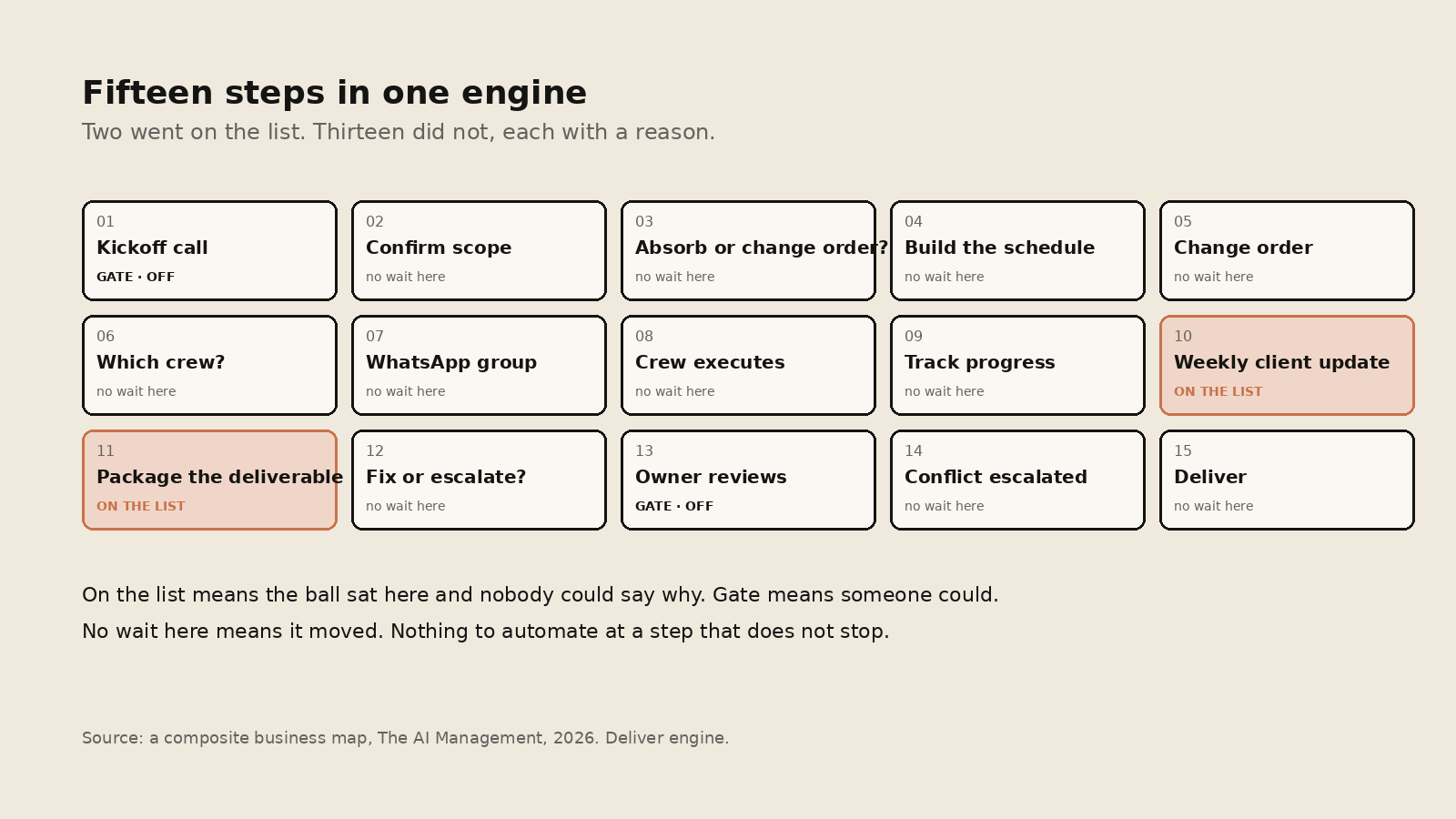
We mapped a technical services company. Thirty-two people, three engines, forty-five steps, fifty-three handoffs. The company is a composite built from thirty real ones we mapped, and every number here is in the map.
Fifteen steps in the delivery engine. At each one we asked who touches it, how long it takes, and how the next person finds out it is their turn.
Some waits, someone could explain. The owner reviews every deliverable before it goes to a client. His operations manager, asked whether that review should exist, said “Yes. Absolutely yes,” and could say what the owner catches. One in eight comes back, always something that would have embarrassed the company.
Some waits, nobody could explain. The operations manager finds out a deal closed when the sales lead mentions it in the hallway. He turned his CRM notifications off a year ago. Nobody decided that.
The first kind stays off the list. The second kind goes on it. Two of the fifteen steps in that engine made the list. Thirteen did not, and the map says why for every one.
Build the whole list
Once you have the candidates, rank them. Two questions, in order.
First, how much is sitting behind it? Not how many hours the task takes. How long the ball waits, and what else waits with it. A step that takes three hours a month can outrank one that takes ten if the three-hour step sits in front of a queue. In that company it did. The owner’s review queue reached nine days, and during one of those waits the client called twice. The step in front of that queue went to the top. The ten-hour task went second.
Then, which part of the business is it in? Every business does three things. It gets customers, it delivers what it sold, and it keeps the customers it has. A stuck flow in each one costs something different.
Stuck in delivery, you are losing a customer you already won and paid to get. Stuck in getting customers, you are losing money you have not earned yet. Stuck in keeping them, you are losing a relationship, and that engine is usually the cleanest, because somebody builds a system for it without being asked.
So when two items sit at the same height on the first question, delivery usually wins. Not always. Usually. In that company the top of the list was in delivery, and the map says why.
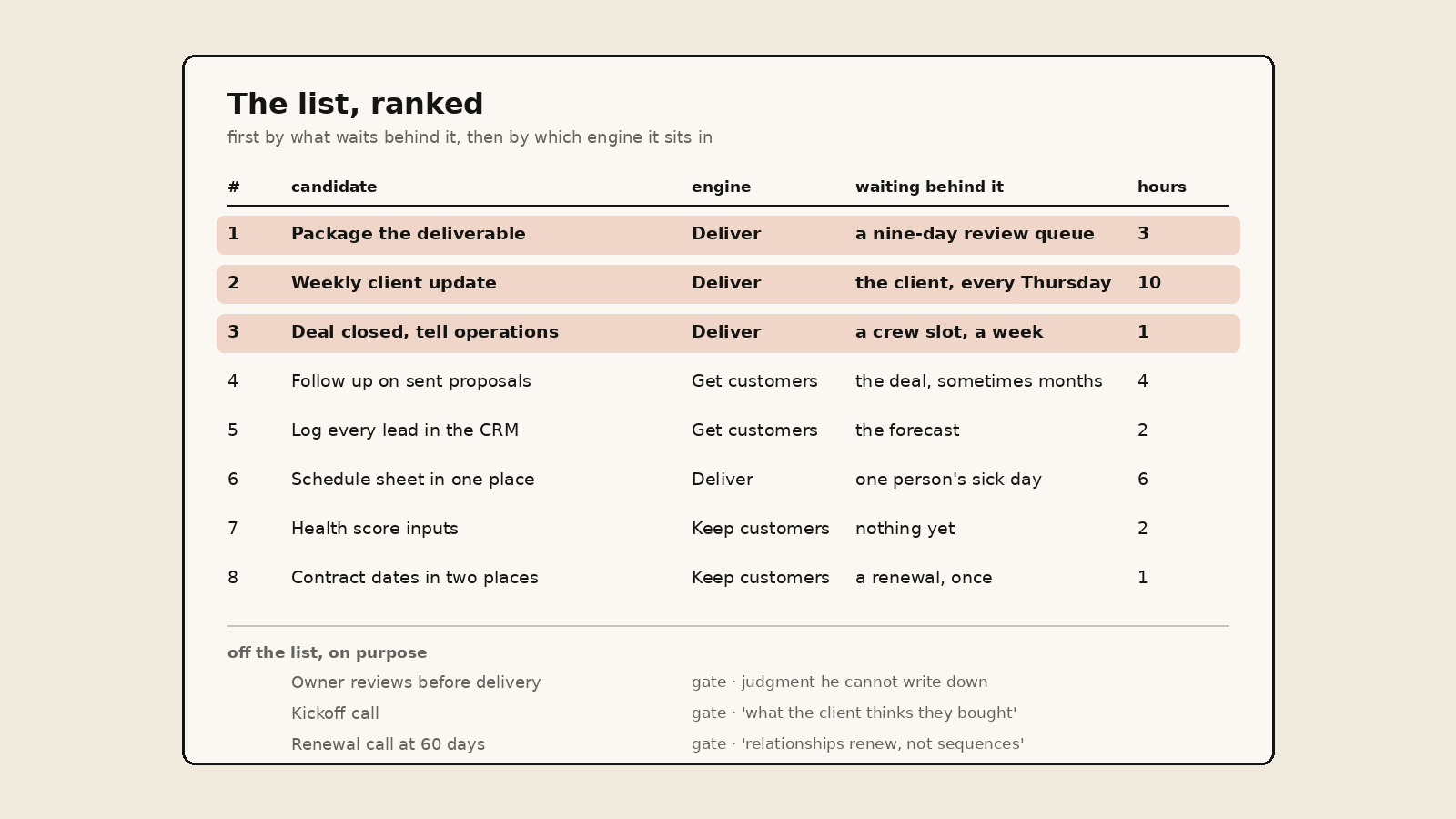
Write the reason next to every item. In six months someone will ask.
See the list with the reasons written on it
A real Blueprint of a thirty-two person company, open to anyone. Every step marked, every gate with its reason, every candidate ranked. Click the owner's review and read the zero.
Open a real Blueprint mapWhat is off the list, and why
Two things never appear.
Gates. A wait that someone can explain. The owner’s review is a gate. In the map it is marked at five hours a month, and AI could cut zero percent of it. We wrote that in the client’s own file, as an AI company. The reason is on the node. The standard for good work is judgment the owner cannot state. “That’s looking at something and knowing whether it’s right. You can’t write that down.” You do not automate a gate. You shorten the line to reach it, which is why the step in front of it went to the top of the list.
Things the people doing the work say must stay human, with a reason. Notice that the people who told us this were never the owner. The operations manager named the kickoff call. “That’s where you find out what the client actually thinks they bought. No machine’s catching that.” The client success lead named every call she makes. “Relationships renew, not sequences.” The sales lead named the first message to a new prospect. “If it reads like a template you’re dead.”
Three people, three engines, three specific steps, each with a reason a machine cannot argue with. Shorter and better than “creativity and relationships.”
The test for the off-list is two questions. Can the person doing the step say what decision is being made there? And would they say it should stay? If both are yes, it is off. If the first is no, it is a gap wearing a habit, and it goes on.
What is last, and what would move it
The bottom of the list is not the same as off it. The bottom is real. It is just not yet.
The owner’s review is off the list today because the standard lives in his head. His coordinator, who packages every deliverable, keeps a private list of nine or ten things the owner sends back. Client name spelled right. Dates match the contract. No internal comments left in. Built over four years. Since he started checking against it, send-backs fell from one in four to one in eight. The owner does not know it exists.
When that list is finished, the review does not go from human to automated. It splits. The checking, which is the list, moves to a machine and runs before anything reaches the owner. The judging, which is the part he cannot write down, stays with him. Same step, two halves, one of them off the list forever and one of them now near the top.
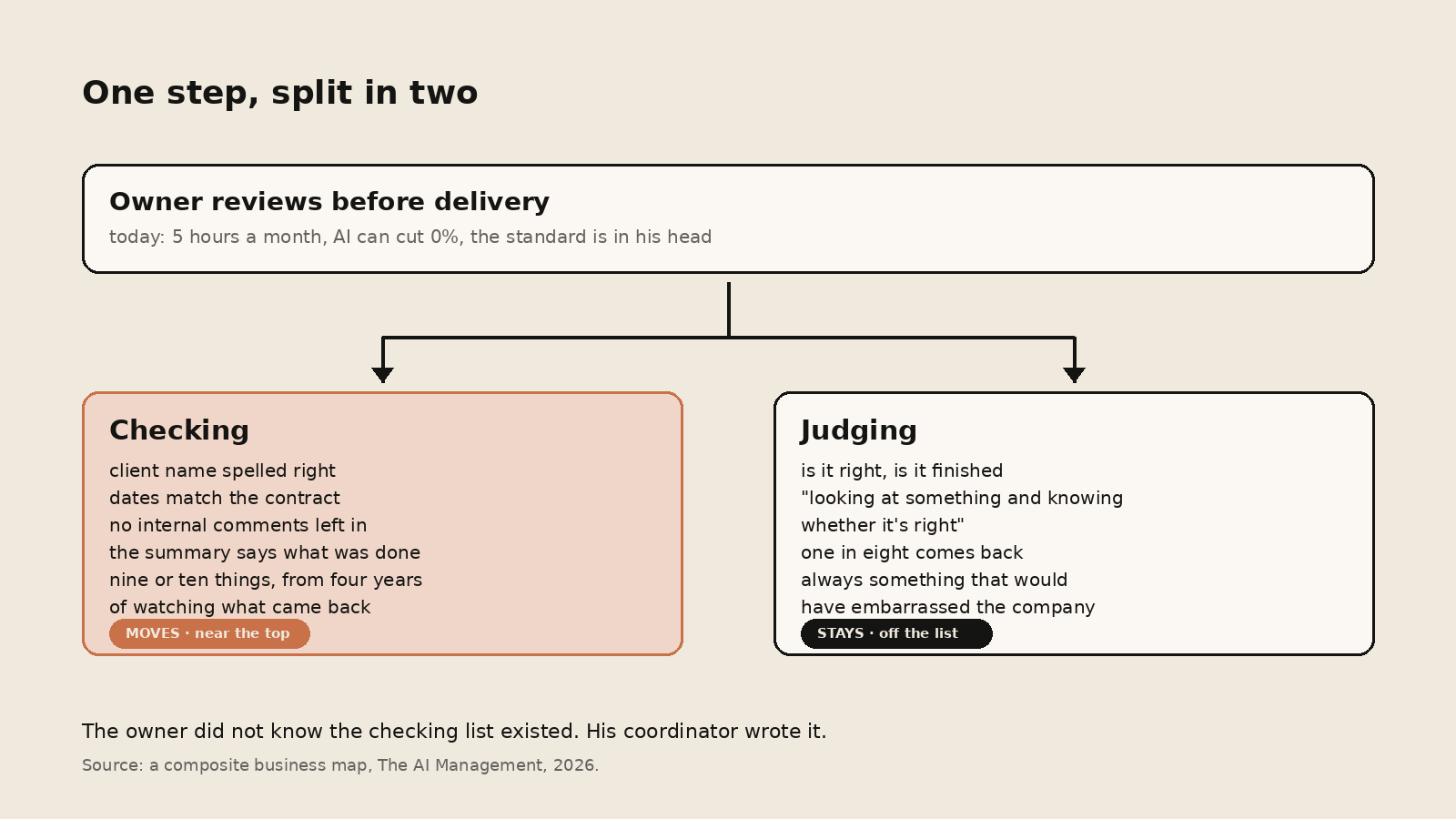
So the bottom of your list is a snapshot. It says “not yet,” and next to it you write what “yet” is waiting on. Usually a standard in someone’s head, not yet written down.
What to do this week
- Pick one job that finished last week. Write every handoff, one line each. Who had the ball, and how the next person found out.
- Mark every place it sat.
- At each mark, ask the person who was there whether they can say what they were deciding. Yes means gate, and it is off. No means gap, and it is on.
- Ask the same person whether the step should stay human, and why. Write the why.
- Rank what is on by how much waited behind it, then by which engine it is in.
- Next to the bottom item, write what would move it up.
You will end up with three short lists. The top, the off, and the not-yet. All three have reasons. That is the answer to what you should not automate, and it is yours, not a category.
What this looks like at full size
One job on paper is one line of the map. Every job, across all three engines, from the owner’s view and the manager’s and the view of the person holding the ball, is all of it. Every wait typed, every gate with its reason, every gap ranked, every not-yet with what it is waiting on.
That is a Blueprint. The exercise above is the same thing at the size you can do this week.
Want the full list for your business, with every reason written next to it?
The Blueprint maps every step across getting, delivering and keeping customers, from three points of view, and ranks every candidate with its reason. Gates marked. Not-yets marked with what they are waiting on. Thirty days, yours to keep.
See the BlueprintNext in this series. How to stop losing leads after hours, without hiring a night shift.
Frequently asked questions
What should you not automate in a business?
Two kinds of things. Gates, which are waits where a person is making a decision they can describe, like an owner's review before delivery. And steps the people doing the work say must stay human, with a reason, like a kickoff call or a renewal conversation. Everything else goes on a ranked list, and the bottom of that list is not yet rather than never.
Why is the usual answer, do not automate judgment or creativity, not enough?
Because it is a category, and a category does not tell you which of your twelve candidates is first, which is last, and which should never appear. A ranked list built from how work actually moves through your business does. The category list comes from people who use AI. The ranked list comes from building it in.
How do I tell if a step in my business should stay human?
Ask the person doing it two questions. Can you say what decision you are making here? And should this stay human, and why? If both are yes, it is a gate and it stays off the list. If the first is no, the wait is a gap, and it goes on the list to be ranked.
How do I rank what to automate once I have the candidates?
First by what is waiting behind each one, not by the hours the task takes. A three-hour step in front of a nine-day queue outranks a ten-hour step with nothing behind it. Then by which engine it sits in. Getting customers, delivering, or keeping them. When two are tied, delivery usually wins, because a stuck flow there costs a customer you already won.
Can a step that should stay human today be automated later?
Often it splits. In one business we mapped, the owner's review was marked at zero percent AI because the standard was judgment he could not write down. His coordinator had written most of it anyway, a private checklist that had already cut send-backs from one in four to one in eight. Finish that list and the checking moves to a machine while the judging stays with the owner.
Which part of the business should I automate first?
Usually delivery, because a stuck flow there loses a customer you already paid to win. Getting customers costs money you have not earned yet. Keeping customers is often the cleanest engine, because somebody builds a system for it without being asked. Usually, not always. The wait behind a step decides before the engine does.