
A quieter phone is two different problems that feel identical, and they need opposite fixes. Either fewer people are reaching the point of calling you, or the same number are calling and you are losing them. You cannot tell which from memory, and your Google Business Profile already has the answer in a graph that takes two minutes to find. If volume is down, the cause is that your customer changed how they look for you. Consumers using AI to get local business recommendations went from 6% to 45% in a single year, and you were never going to see that happen in any dashboard you own.
Two problems, one feeling
The phone is quieter than it was. Nothing about your business changed. Same crew, same work, same reviews, and your regulars still call.
That feeling is two entirely different problems wearing the same clothes.
Fewer people are reaching the point of calling you. They still need what you do. They are just not arriving at the moment where they pick up the phone.
The same number are calling and you are losing them. The volume is unchanged. What changed is what happens in the seconds after they dial.
Both feel like a slow month. They need opposite fixes. If you buy an answering service for a visibility problem, you have paid to automate silence. If you rebuild your website for an answering problem, you have paid to send more people to a phone nobody picks up.
Search this question and you will find two kinds of article, and neither asks which one you have. One kind says your marketing is not working and you should spend more. The other kind says you are missing calls you do not know about, here are some alarming numbers, buy this. Both assume they already know.
You can find out in two minutes, for free, from data you already own.
The two-minute check
Open your Google Business Profile. Find the performance section and look for calls. Set the window as wide as it will go.
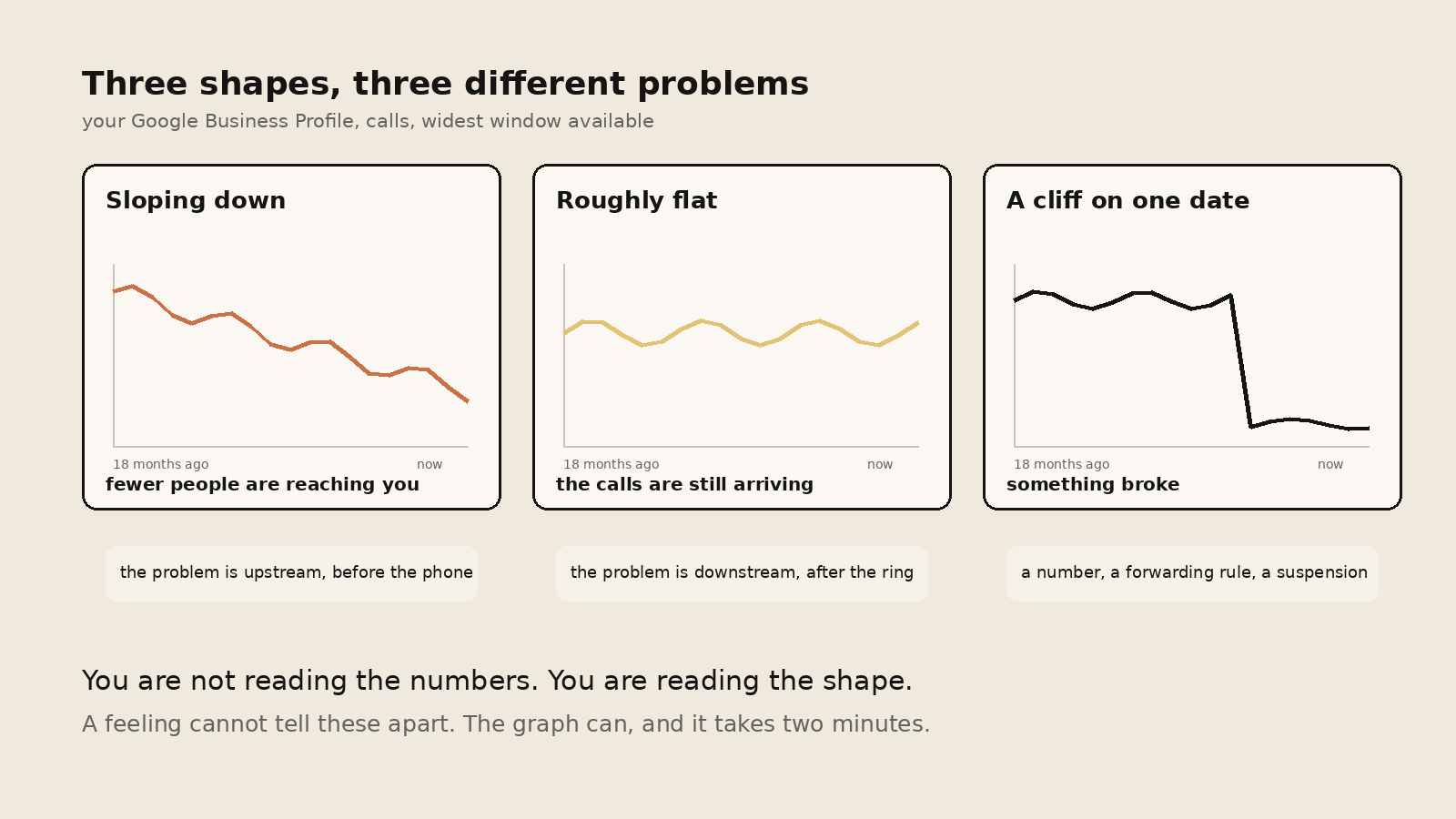
You are not reading the numbers. You are reading the shape of the line.
A line that slopes down over a year or more means fewer people are reaching you. The problem is upstream, before the phone. Keep reading.
A line that is roughly flat means the calls are still arriving. Your problem is downstream, in what happens after the ring. Skip to the last two sections.
A line that drops off a cliff on one date means something broke. A number changed, a forwarding rule, a profile suspension. Check what you changed that week.
If your calls do not come through the profile, do the same thing with whatever you do have. Your phone bill shows inbound volume. Your booking software shows a trend. The point is to look at eighteen months of your own data instead of trusting a feeling, because a feeling cannot tell the difference between these two problems and the graph can.
One caution. Calls through your Google profile are only the calls that came through your profile. If you also get calls from a website form, a truck, or a referral, the graph is a sample rather than the whole picture. It is still the best two minutes you will spend on this.
What actually changed
Assume your line slopes down. Here is the honest cause, and almost nobody is telling business owners about it plainly.
Your customer changed how they look for you, and nobody announced it.
In BrightLocal’s 2026 Local Consumer Review Survey, a representative panel of 1,002 US adults, the share of consumers who used an AI tool to get a local business recommendation in the past year went from 6% to 45%. Not 6% growth. Six percent to forty-five percent, in twelve months. That makes AI the third most common way people find local businesses, behind Google and Facebook, and ahead of Yelp and Tripadvisor.
Over the same period, Google’s share of local business discovery fell from 83% to 71%.
A separate study by Yext, using a different method on 1,120 adults, found 47% had used AI to search for a local business in the previous month. Different question, different sample, same direction.
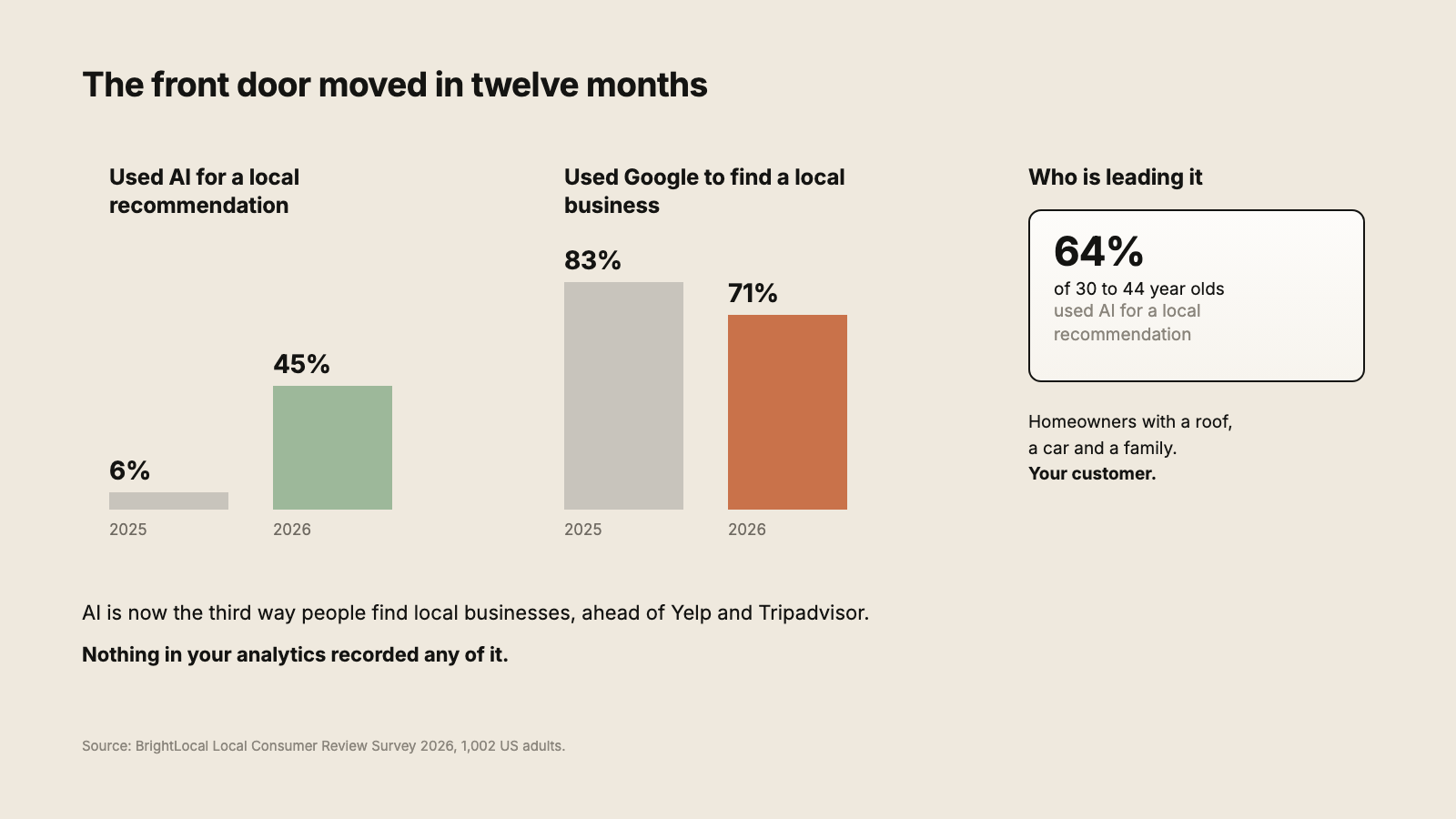
The people leading the change are not teenagers. The heaviest adopters are 30 to 44 year olds, at 64%. Homeowners with a mortgage, a roof, a car and a family. Your customer.
And it is not only the assistants. Whitespark found AI answers now appear on roughly 68% of local business queries on Google itself, against 39% for the traditional local pack. Ahrefs looked at 300,000 keywords and found that when an AI answer appears, clicks to the number one result fall by 58%.
Read that last one twice. Your ranking did not have to change for your traffic to halve.
Why you never saw it happen
Here is the part that makes this so frustrating, and it is worth understanding because it explains three years of confusion.
Nothing in your analytics records a recommendation you were left out of.
When someone asked an assistant for a plumber and got three names that were not yours, there was no impression. No click. No line in Search Console, no dip in a report, no notification. The loss leaves no trace anywhere you would think to look.
Compare that to the old world. If you fell from position three to position eight on Google, your impressions stayed and your clicks dropped, and the shape of that was visible. You could see it and argue about it. This new loss is silent.
Which is also why the advice you have been given did not work. You were told to post more, get more reviews, spend more on ads. All reasonable, all aimed at a list your customer is no longer scrolling.
What being left out actually means
One correction, because the panicked version of this story is wrong and the accurate version is more useful.
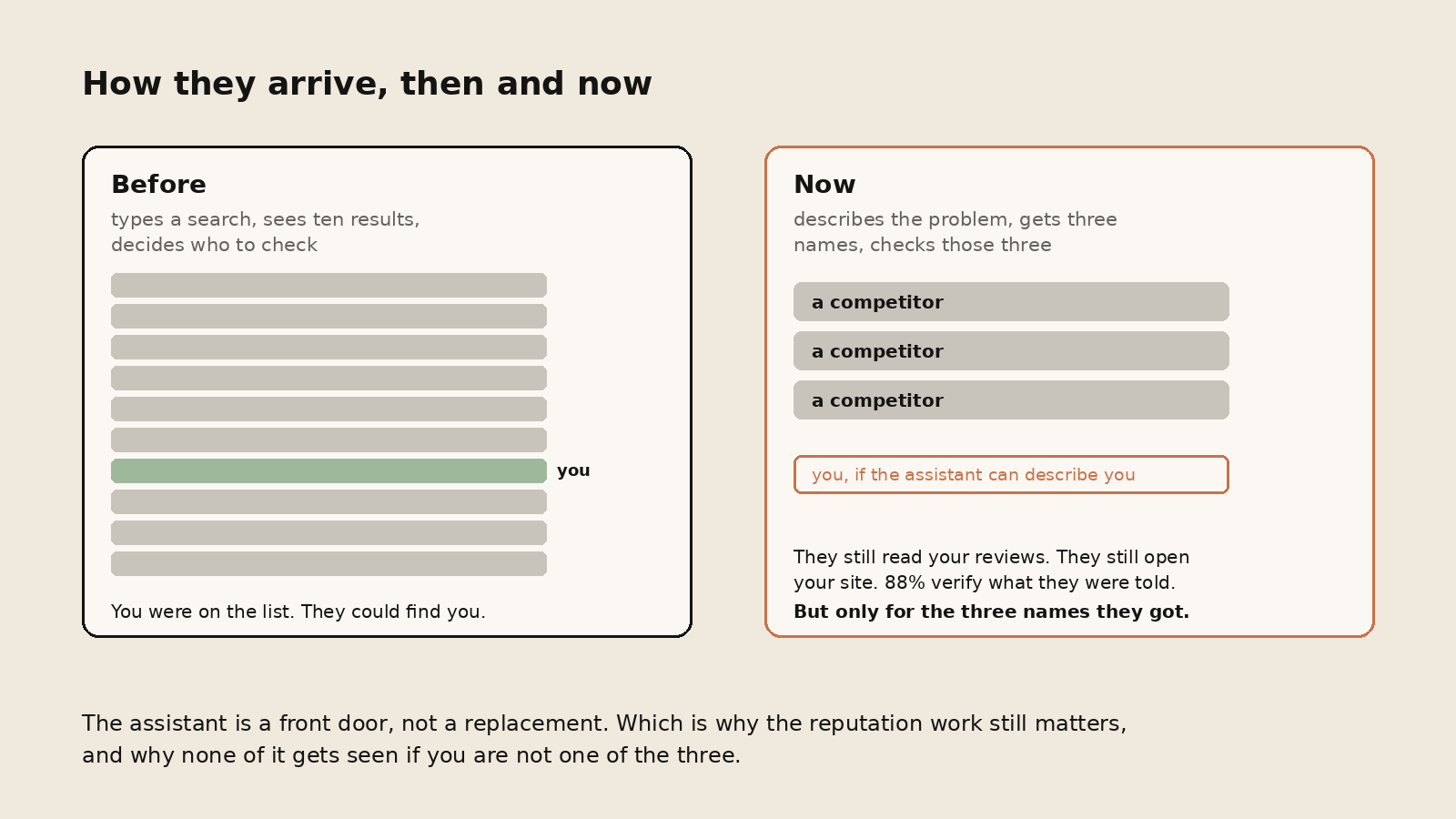
AI did not replace how people evaluate a business. The same survey found 88% of consumers verify what an assistant tells them, and 97% of people who use AI for recommendations at least sometimes check it against real reviews.
So they still look at your star rating. They still read what customers said. They still open your website.
What changed is how they arrive. They used to open Google, see ten results, and choose who to check. Now they describe their problem, get handed three names, and check those three. Everything after that is the same as it always was.
The assistant is a front door, not a replacement. That is good news, because your reviews and your reputation still matter enormously. It is also the whole problem, because if you are not one of the three names, none of that work ever gets seen.
If the assistants cannot read your site
That is the first thing to fix, and it is not a content problem. The previous article in this series has the ten-second check and the two prompts that tell you what an assistant can and cannot see about your business.
Why isn't ChatGPT recommending my business?If your line was flat
Different problem, and the fix is nearer to hand.
The calls are still coming. You are losing them between the ring and the conversation. After hours, during a job, at lunch, on the second ring while you are under a sink.
What has changed here is the cost of each one. In the same BrightLocal survey, 97% of consumers read reviews before choosing a local business, and 41% now say they always do, up from 29% the year before.
Think about what that means for the person dialling your number. They did not find you and call you on impulse. They found you, read your reviews, formed an opinion, and decided you were the one. By the time your phone rings, they have already chosen you.
A missed call in 2020 was a stranger who might have called someone else anyway. A missed call today is a customer who had already picked you and then heard nothing. They do not conclude that you are busy. They conclude that you do not need the work, and they call the next name on the list, which the assistant already gave them.
That is a solvable problem, and it does not need a new website. It needs the call answered, or a text going back within a minute, or a way for them to book without talking to anyone.
What to do this week
If your line slopes down.
- Ask an assistant for a recommendation the way a customer would. Not your business name. “Best roofer in Hialeah.” Ask it three different ways on three different days, because the answer moves.
- Write down who it named. That is your actual competition now, and it is often not who you thought.
- Open your own homepage with JavaScript turned off in your browser. If it comes up blank, the assistants have never been able to read your site, and that is the first thing to fix.
- Make your Google profile and your website agree exactly. Name, phone, hours, services.
If your line is flat.
- Count your missed calls for one week. Just count them. Most owners are wrong about this number and the direction of the error is always the same.
- Look at when they cluster. Lunch, after five, weekends. That tells you whether you need coverage or a system.
- Set up a text that goes out automatically when a call is missed. Not a voicemail greeting. A text, within a minute, while the problem is still live in their head.
- Give them a way to book that does not require reaching a person.
Either way, do the two-minute check first. Everything above depends on knowing which line you have, and half of it is wasted effort on the wrong problem.
If your line slopes down, this is the rebuild that fixes it
Every word in the page before any script runs, a page for each service and each area, your profile and your site saying the same thing. Seven business days, everything registered in your name, and the addresses that already earn you visitors kept.
See the First StepNext in this series. Great reviews, still invisible. Why Google and ChatGPT don’t show you.
Frequently asked questions
Why is my business phone ringing less than it used to?
It is one of two problems that feel the same. Either fewer people are reaching the point of calling you, or the same number are calling and you are losing them after the ring. Open your Google Business Profile, find the calls graph and set the widest window. A line sloping down means the problem is upstream. A flat line means it is downstream. They need opposite fixes.
How do I find out if my calls are actually down or if it just feels that way?
Your Google Business Profile keeps a calls graph in the performance section. Set the window as wide as it allows and read the shape rather than the numbers. Eighteen months of your own data settles in two minutes what a feeling cannot settle at all. If your calls do not come through the profile, use your phone bill or booking software for the same trend.
Are customers really using AI instead of Google to find local businesses?
Increasingly, yes. BrightLocal's 2026 Local Consumer Review Survey of 1,002 US adults found the share using AI tools for local business recommendations went from 6% to 45% in one year, making AI the third most common discovery channel behind Google and Facebook. Over the same period Google's share of local discovery fell from 83% to 71%.
Why didn't I see this in my analytics?
Because a recommendation you were left out of leaves no trace. There is no impression, no click and no line in Search Console for an answer that named three other businesses. That is different from falling in Google rankings, where impressions stay and clicks drop in a visible shape. This loss is silent, which is why most owners find it late.
Does my Google ranking still matter if people are asking AI?
Yes, and it produces fewer calls than it used to at the same position. Whitespark found AI answers now appear on roughly 68% of local business queries, and Ahrefs measured a 58% drop in clicks to the number one result across 300,000 keywords when an AI answer is shown. Your ranking did not have to change for your traffic to fall.
Do reviews still matter now that AI makes the recommendation?
More than ever, and for a specific reason. The same survey found 88% of consumers verify what an assistant tells them, and 97% of AI users at least sometimes check against real reviews. The assistant is a front door rather than a replacement. Your reputation still closes the sale. It just never gets seen if you are not one of the names the assistant hands over.
What does a missed call cost now compared to a few years ago?
More, because the caller had already decided. BrightLocal found 97% of consumers read reviews before choosing a local business and 41% now always do, up from 29%. By the time your phone rings, that person has read your reviews and picked you. When nobody answers, they do not assume you are busy. They call the next name they were given.