
Three things have to be true before an AI assistant will recommend your business, and they have to be true in this order. It has to be able to read your website at all, which most guides never mention and you can test in ten seconds by turning JavaScript off. It has to understand what you actually do, which you can check by asking it. And it has to be able to see the path your customer walks, which means a page for each question they ask along the way. Reviews, directories and listings matter, and they matter after these three. Fixing them first is why most owners see no change.
The ten-second check, before anything else
Turn JavaScript off in your browser and load your own homepage.
In Chrome, open Settings, search for JavaScript, and switch it to blocked. Then visit your site. Do not skip this because it sounds technical. It takes ten seconds and it decides whether the rest of this article can help you.
If your page loads complete, with your headline, your services, your phone number, all of it, you pass. Move on to the next section.
If the page is blank, or shows a spinner, or shows a menu and nothing else, stop reading and call whoever built your site. That blank page is what ChatGPT sees.
Here is why. Google spent about a decade building the ability to run a website’s code before reading it, the same way your browser does. The AI assistants your customers now ask never built that. Vercel and MERJ measured hundreds of millions of real crawler visits and found that GPTBot, ClaudeBot and PerplexityBot execute zero JavaScript. They download the code files. They never run them. They read whatever text is sitting in the page before any script does anything.
Most websites built in the last five years are applications. The words arrive after the code runs. Google is fine with that. ChatGPT is not.
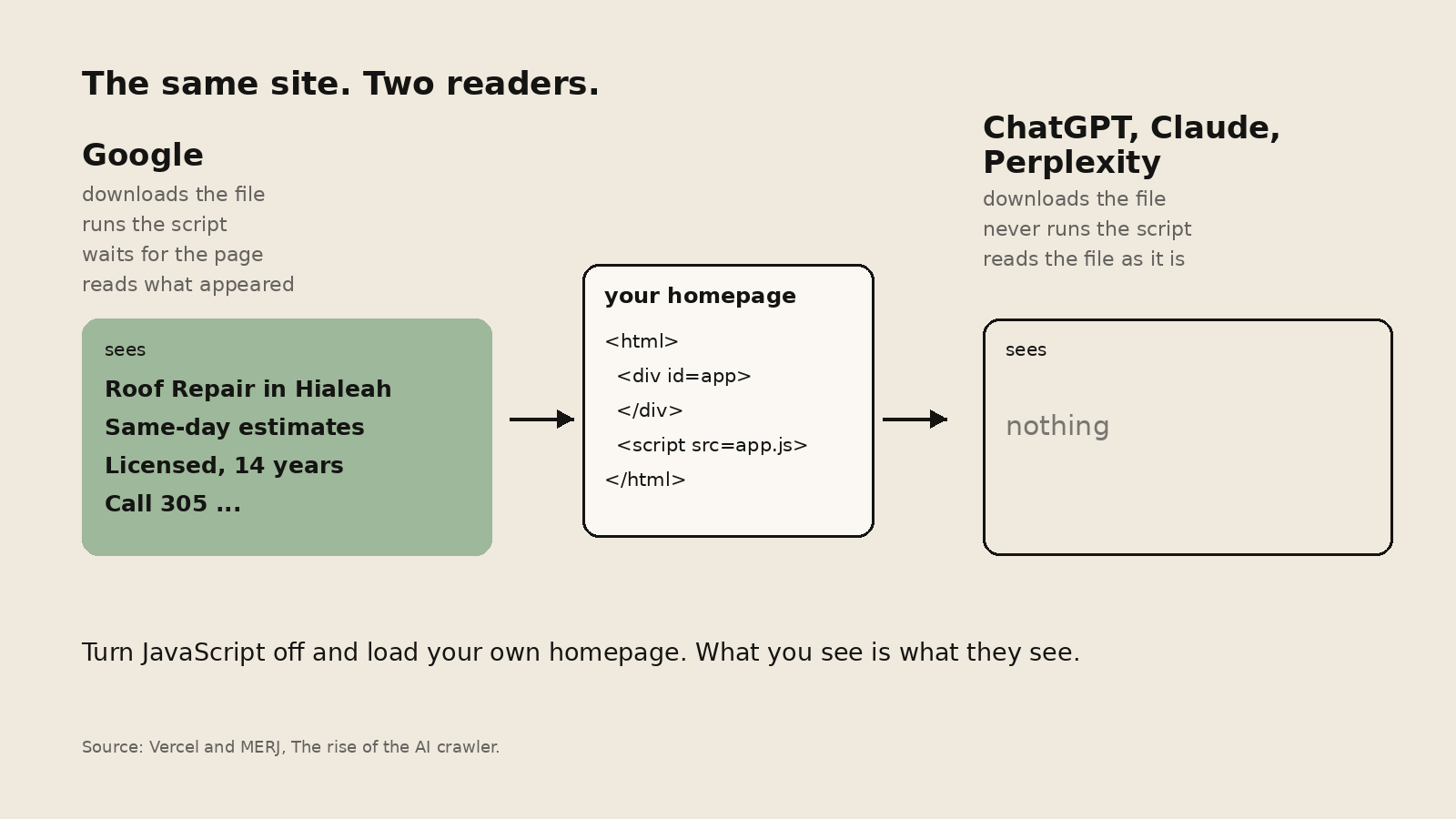
Every guide on this question will tell you to structure your content so AI can extract it. That advice is correct, and it is useless if the content is not there to begin with. You cannot structure something the reader never receives.
So that is check one, and almost nobody tells you to run it.
What actually happens when someone asks
Before the other two checks, it helps to know what you are up against.
When a customer asks an assistant for a recommendation, it does not consult a ranking. It searches, reads what comes back, and names the businesses it can describe with confidence. Everything else it stays vague about.
And it names very few. SOCi’s 2026 Local Visibility Index looked at more than 350,000 business locations and found ChatGPT recommended 1.2% of them. Perplexity recommended 7.4%. For the same businesses, Google’s local three-pack showed 35.9%.
So the honest version of your question is not why it skipped you. It skips almost everyone. The seats are few, and the businesses that get one are the businesses it can describe without guessing.
That is the whole game. Being describable.
Ask it what you do
Now check two. This one is a question, not a tool, and it takes a minute.
Open ChatGPT or Gemini with web search on and paste this.
I am going to give you a website. Read it and answer these questions
using only what is on that site. Do not use anything you already know
about the company.

1. In one sentence, what does this business do?
2. Who is it for, specifically?
3. Where does it operate?
4. What exactly can I hire them to do? List the services.
5. Who works there and what makes them qualified?
6. What would I do next if I wanted to hire them?

If the site does not answer one of these, say "not stated" rather
than guessing.

The website is: [your URL]
Read the answer against what you believe your business is.
Most owners get a surprise here, and it is usually one of three kinds. The description is vaguer than the business. The services are missing or incomplete. Or “not stated” appears next to something you would have sworn was obvious.
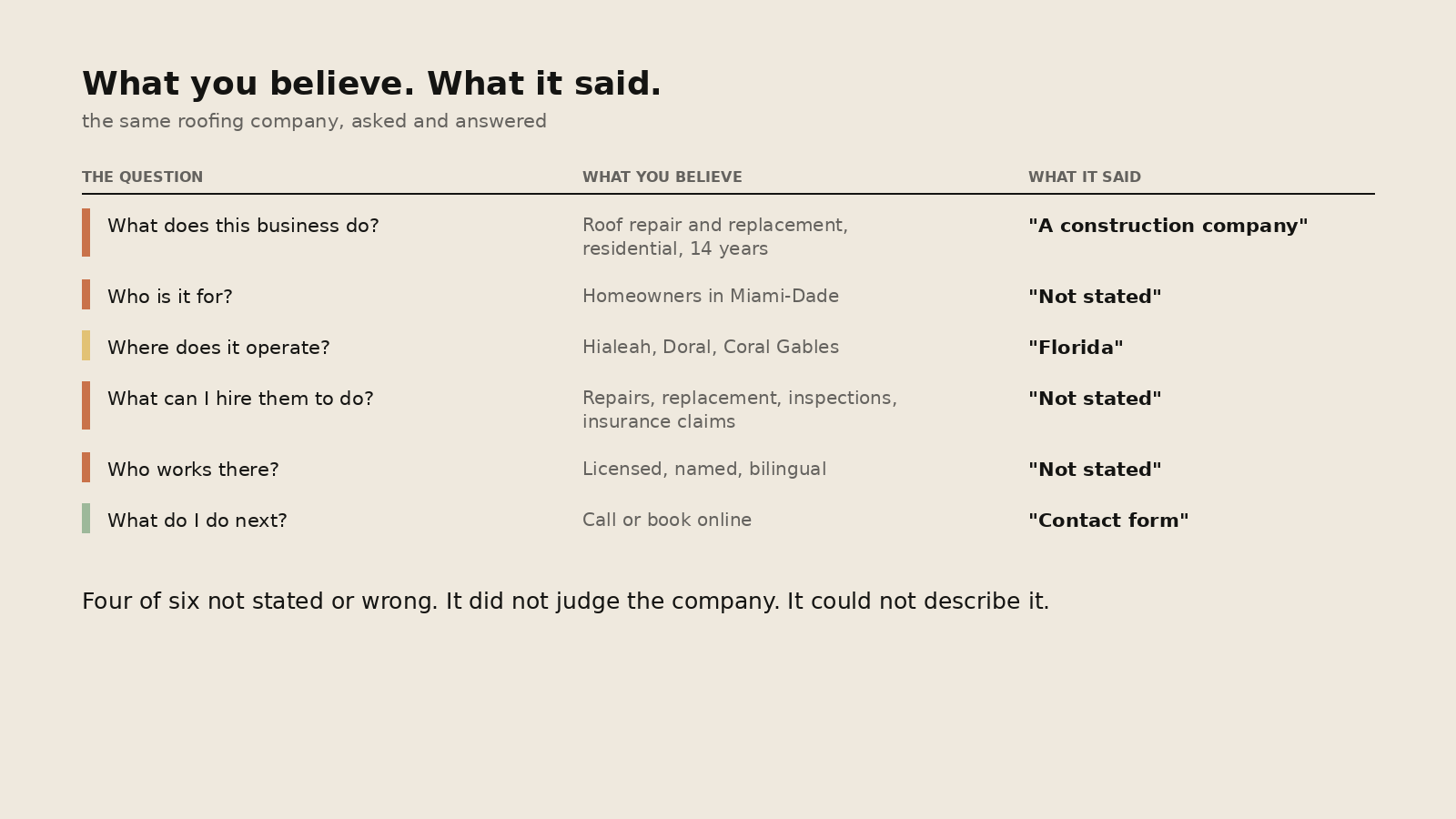
If the answer does not match, you have found the first real reason. The assistant did not judge you and choose someone better. It could not describe you, so it described someone it could.
The fix is smaller than a rebuild, and you can start this week. Your homepage says what you do, for whom, and where. Then one page for each service, each one written for the thing a customer actually searches for. Someone looking for a will does not search for a law firm. They search for a will.
That gets you clarity while the rest of the site waits its turn.
Can it see the path your customer walks?
Check three, and this is the one almost nobody thinks about.
Here is the simple version. A customer does not arrive ready to call you. They walk a path, and at every step they have one question. If nobody answers that question, they stop walking.
The path looks like this, in order.
Something is wrong. A noise, a leak, a letter from the county. They do not know what to call it yet.
Who fixes this? Now they are looking for a kind of business.
Who fixes this near me? Now they are looking in their own city or neighbourhood.
Are these people real? They want a name, a licence, a face, a number of years.
What will it cost and how long will it take? They will not ask you. They will look, and if they cannot find it, they will look at someone else.
How do I start? A phone number, a form, a calendar.
Six steps, six questions. Every one of them is a question a real person types into a real box, and every one of them needs something on your website that answers it.
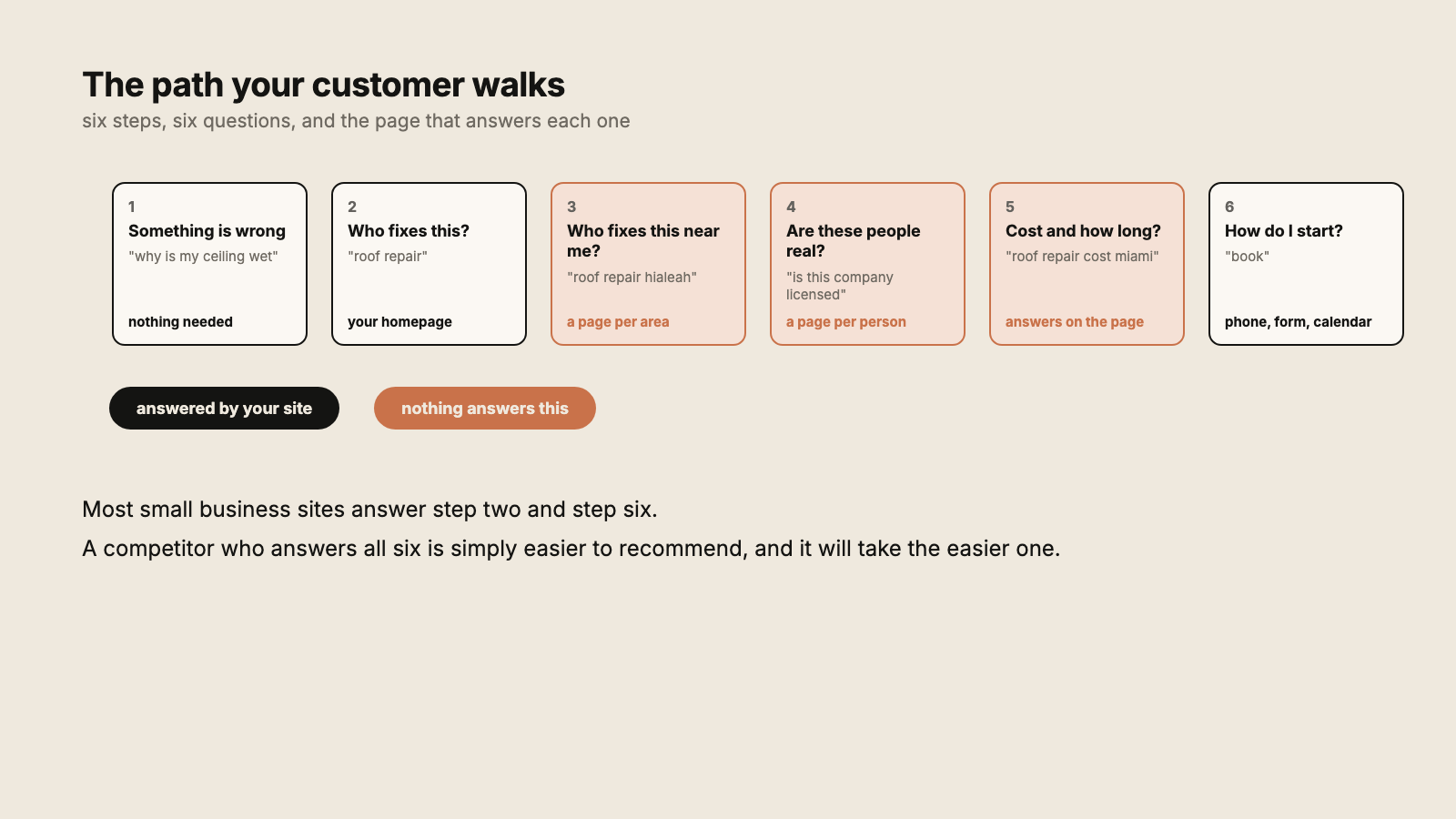
Now count what you have. Most small business websites have a homepage, an about page, a services page that lists everything in one paragraph, and a contact form. That answers step two and step six. Four steps have nothing.
That is not a content gap. That is the reason an assistant cannot vouch for you. It can see that you exist and that you do something in your category. It cannot see that you do this specific thing, in their specific city, with real people who are qualified, for a price in a range, starting on Tuesday. A competitor whose site answers all six is simply easier to recommend, and the assistant will take the easier one every time.
You can check this one too. Paste this.
Act as a customer who has this problem: [describe the problem your
best customer had before they called you].

Walk me through the questions you would ask, in order, from the
moment you notice the problem to the moment you pick a company to
call.

Then read this website and tell me, for each question, whether the
site answers it. Quote the sentence that answers it, or say
"nothing on the site answers this".

The website is: [your URL]
The output is your to-do list, in the order your customer walks it.
Why this order, and not the one you have read everywhere else
Search this question and you will find the same six causes on every page. Your name and phone number conflict across the web. You are missing from the directories the assistant reads. Your content is not structured for extraction. Your reviews are thin. Competitors out-signal you. Answers vary every time you ask.
All six are real. Every one of those articles is right about them.
The problem is that they are presented as a flat list, and an owner with two spare hours a week works from the top. If the list is unordered, you spend those hours on the wrong thing.
Here is the order that matters, and the reason for it.
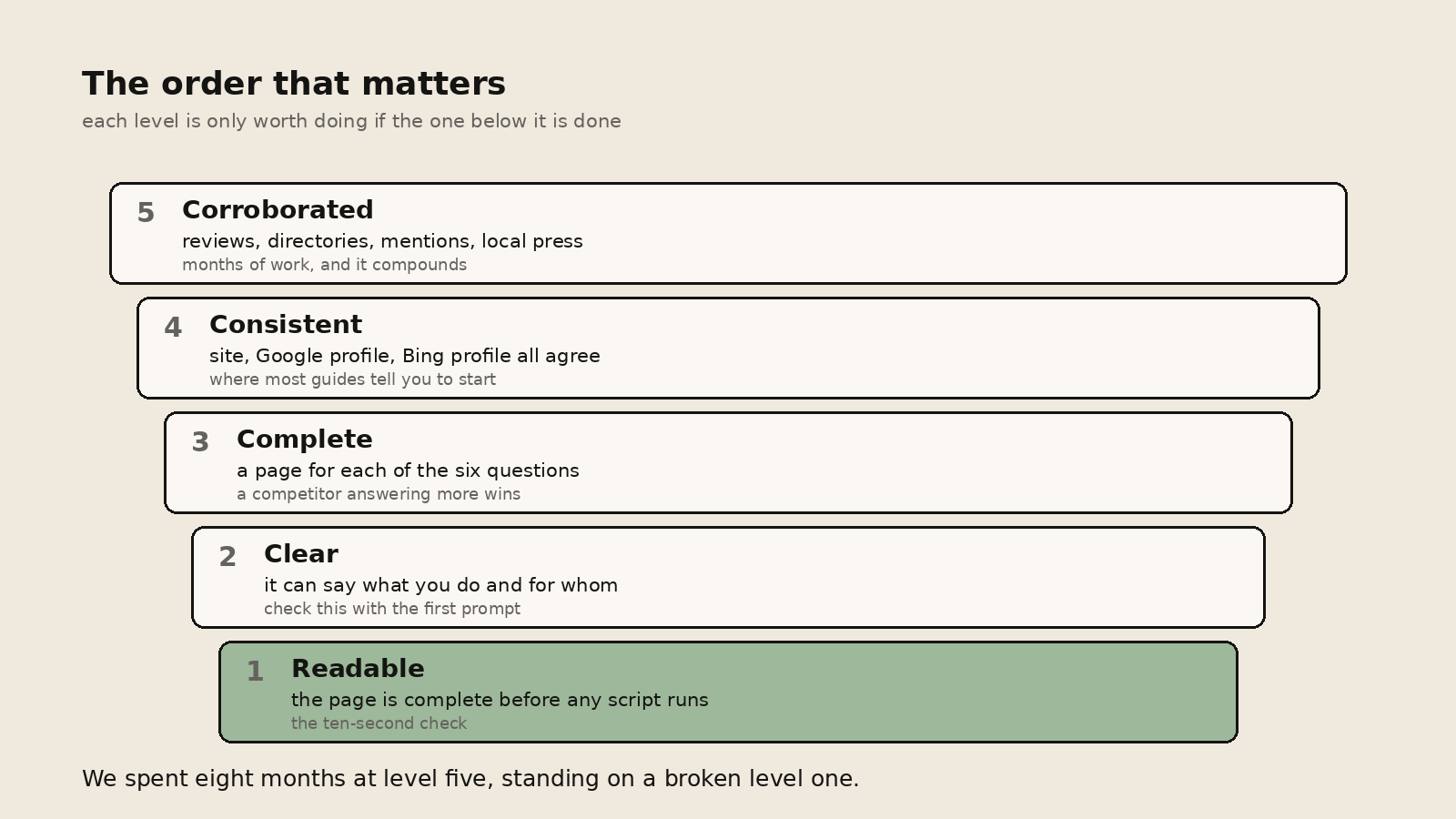
One, readable. If the crawler receives a blank page, nothing above this can help. Reviews, listings, directories, all of it, sitting on top of a page nobody can read.
Two, clear. If it can read your site but cannot say what you do, it will not name you, no matter how many reviews you have.
Three, complete. If it knows what you do but the six-step path has four gaps, it can describe you and still not recommend you, because a competitor answers more of the question.
Four, consistent. Now your name, phone, hours and services need to match across your site, your Google profile, your Bing profile. Three sources agreeing is what turns a description into a recommendation. This is where most guides tell you to start, and it is genuinely important, and it is level four.
Five, corroborated. Reviews, directories, mentions, local press. The outside world saying the same thing you say. This compounds, it takes months, and it is worth every bit of the effort, once one through four are done.
None of this is a trick, and nobody can promise you a recommendation. Anyone who does is selling you something, because the answer changes with the assistant, the wording, the city and the day.
Next in this series
Your phone rings less than it did, your reviews are good, and nothing about your business changed. What changed is how customers look for you, and the shift happened without anyone telling you.
Why is my phone ringing less?We were invisible for eight months
We are the company that sells this, and our own website could not be found by any AI for eight months.
Here is the part worth your attention. We would have passed the checklist on every one of those eight articles. Our listings were consistent. Our copy was clear and written by people who do this for a living. We had structured data. On paper we were fine.
We were invisible because of level one. The site was built as an application, the words arrived after the code ran, and the assistants were reading an empty page. No amount of review-building would have touched it. It was not an editorial problem. It was structural, and the only way to find it was the ten-second check at the top of this article.
We rebuilt it so the page is complete before any script runs, then worked up the ladder. Over the six months after, indexed pages went from 13 to 33, impressions from 3,190 to 11,500, Bing from zero to 302, and we passed 3,000 AI citations. Those are our own Search Console and Bing Webmaster numbers.
We tell you that because it is the fastest way to explain why the order matters. We spent eight months at the top of the ladder, wondering why nothing worked, standing on a broken bottom rung.
What to do this week
- Turn JavaScript off, load your homepage. Complete, or blank? If blank, that is your whole answer and everything else waits.
- Run the first prompt. Read what it says you do against what you believe you do.
- Run the second prompt. You now have a list of the questions your customer asks that your site does not answer.
- Fix your homepage so it says what you do, for whom, and where, in the first screen.
- Pick your single most profitable service and give it its own page, written for the thing a customer searches for.
- Open your Google Business Profile next to your website and make the name, phone, hours and services match exactly.
- Only then start on reviews and directories. They compound, and they compound on top of the four things above.
Ask the assistant the same question again in a month. Ask it several ways, on several days, because the answer moves. What you are watching for is not a position. It is whether you appear at all, and how often.
If the ten-second check came back blank
That is level one, and it cannot be fixed in place. The First Step is a rebuild that puts every word in the page before any script runs, gives each service and each area its own page, and keeps the addresses that already earn you visitors. Seven business days, registered in your name.
See the First StepNext in this series. Why is my phone ringing less? What changed in how customers find you.
Frequently asked questions
Why isn't ChatGPT recommending my business?
Usually one of three things, and they have an order. It cannot read your website at all, because the text arrives after JavaScript runs and AI crawlers do not run JavaScript. Or it can read the site but cannot say what you do. Or it knows what you do but your site does not answer the questions a customer asks along the way, so a competitor who answers more is easier to recommend. Listings and reviews matter after those three.
How do I check if ChatGPT can read my website?
Turn JavaScript off in your browser and load your own homepage. In Chrome, open Settings, search for JavaScript and switch it to blocked. If the page loads complete, you pass. If it is blank or shows only a menu, that blank page is what ChatGPT sees. It takes ten seconds and needs no tool.
Do AI assistants really not run JavaScript?
Correct. Vercel and MERJ measured hundreds of millions of real crawler visits and found zero JavaScript execution by GPTBot, ClaudeBot or PerplexityBot. They download the script files and never run them, then read whatever text is already in the page. Googlebot is different, which is why a site can rank on Google and be blank to ChatGPT.
What percentage of businesses does ChatGPT actually recommend?
Very few. SOCi's 2026 Local Visibility Index looked at more than 350,000 business locations and found ChatGPT recommended 1.2% of them, against 35.9% visibility in Google's local three-pack. Perplexity recommended 7.4%. So the honest version of the question is not why it skipped you, but what makes a business describable enough to get one of the few seats.
Why does ChatGPT recommend my competitor instead of me?
Because it can describe them without guessing and it cannot describe you. An assistant names businesses whose facts it can verify and stays vague about everyone else. If your competitor's site answers what they do, where, who works there and what it costs, and yours answers two of those, theirs is the safer recommendation.
Can I pay to be recommended by ChatGPT?
No, and nobody can guarantee a recommendation. The answer changes with the assistant, the wording, the customer's location and the day. What you can do is make your business readable and describable, which is what makes a recommendation possible. Anyone promising placement is selling you something.
How long does it take to show up in AI recommendations?
Months, not days, and the first level moves fastest. A rebuild that makes the site readable can change indexing within weeks. Reviews, directories and outside mentions compound over months. Our own site went from invisible to roughly 3,000 AI citations in under six months, with the structural fix first and the rest built on top.